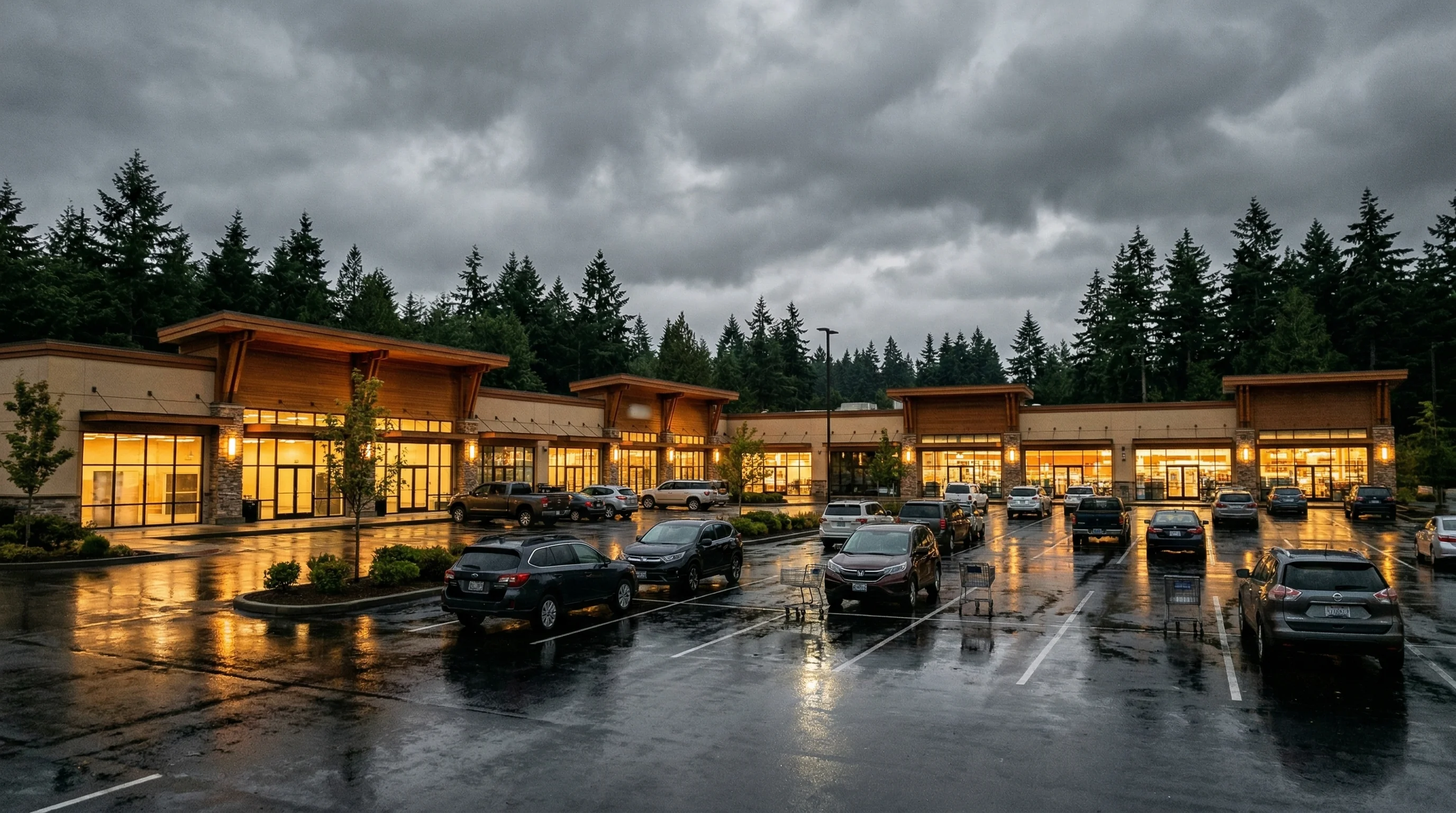
Washington Leads the Nation in Retail Theft: What It Means for Stores Across the Puget Sound
A Forbes Advisor analysis ranked Washington first in the nation for retail theft impact. Fred Meyer is closing six stores across western Washington, citing theft and regulatory costs. King County prosecutors charged 640 felony retail crime cases in 2025 — the highest in five years. In Lynnwood, shoplifting arrests have risen 666% since 2015. The state legislature is weighing 11 organized retail crime proposals. And the stores that remain open are left wondering what happens next.
Quick Answer
How bad is retail theft in Washington state compared to the rest of the country?
Washington ranks #1 nationally for retail theft impact according to Forbes Advisor, with 48% more reported retail thefts than expected based on population. The state loses roughly $2.7 billion annually to retail theft, translating to $603 million in missed state and local tax revenue. King County prosecutors filed 640 felony economic and property crime cases in 2025, a five-year high. Fred Meyer is closing six stores across western Washington, and Rite Aid closed 27 Washington locations in September 2025. The state legislature is considering 11 organized retail crime proposals, and the Attorney General's Organized Retail Crime Unit has secured its first convictions. Mobile surveillance in retail parking lots has been shown to reduce property crime by up to 51% according to meta-analysis research.
The Numbers That Put Washington on Top
In 2024, Forbes Advisor published a state-by-state analysis of retail theft and Washington came out on top. Not in a way anyone here would celebrate. The state sees 48% more reported retail thefts than it should based on its population size. In terms of dollar value, $347 in goods are stolen for every Washington resident every year — the third highest per-capita rate in the country, behind only Pennsylvania and California.
The Washington Retail Association puts it in even starker terms. In 2021, Washington retailers lost approximately $2.7 billion to theft. That's not just a loss for the stores. It translates to roughly $603 million in state and local tax revenue that never gets collected. That's money that would otherwise fund schools, roads, and public safety. The irony isn't lost on anyone: theft is depleting the tax base that pays for the law enforcement that's supposed to stop it.
Nationally, the problem is enormous. The National Retail Federation reported that U.S. retailers lost $121.6 billion to shrink in 2024. External theft — shoplifting and organized retail crime — is the largest single contributor. And 67% of retailers reported a year-over-year increase in organized retail crime incidents, according to the NRF's 2025 Retail Security Survey.
But Washington isn't just following the national trend. It's leading it. The FBI's data shows 3,510 commercial theft cases per 100,000 businesses in Washington — the highest rate in the country. And it's getting worse, not better.
What's Actually Happening on the Ground
The statewide statistics tell the broad story. But the incidents happening in specific cities across the Puget Sound are what make it real.
Lynnwood: Ground Zero
In 2015, Lynnwood police made 166 shoplifting arrests. By 2024, that number had climbed to 1,272 — a 666% increase. Total theft incidents in Lynnwood reached 2,364 in 2024. And the Alderwood Mall area, the city's retail center, has become what one attorney called "a hotspot that glows in terms of retail theft numbers."
In March 2025, Lynnwood police ran an emphasis operation at a single Fred Meyer store and arrested 15 people for retail theft. Half of them weren't from the city. They were traveling to Lynnwood specifically to steal.
The $200,000 Ulta Beauty Spree
Shellonda Daniel stole over $200,000 in merchandise from Ulta Beauty stores over 14 months, committing 28 thefts across five counties — hitting stores in Auburn, Federal Way, Renton, Puyallup, Tukwila, Lynnwood, Olympia, Bellingham, and multiple Seattle locations. She was sentenced in November 2025 under a mental health sentencing alternative that kept her out of prison. Cases like this highlight both the scale of individual offenders and the jurisdictional challenges when one person hits stores across the entire western half of the state.
Kent: Stings and Stolen Guns
In September 2025, Kent police arrested seven people during a shoplifting sting at a single Safeway. One of the suspects — a 21-year-old from Tacoma — ran from officers and was found hiding nearby with a loaded, stolen handgun. In a separate operation, Kent police arrested 12 people for shoplifting across eight stores on the East Hill, including Ross, Home Depot, Harbor Freight, and Target.
These aren't isolated events. They're snapshots of what's happening in retail corridors throughout King and Pierce counties every week.
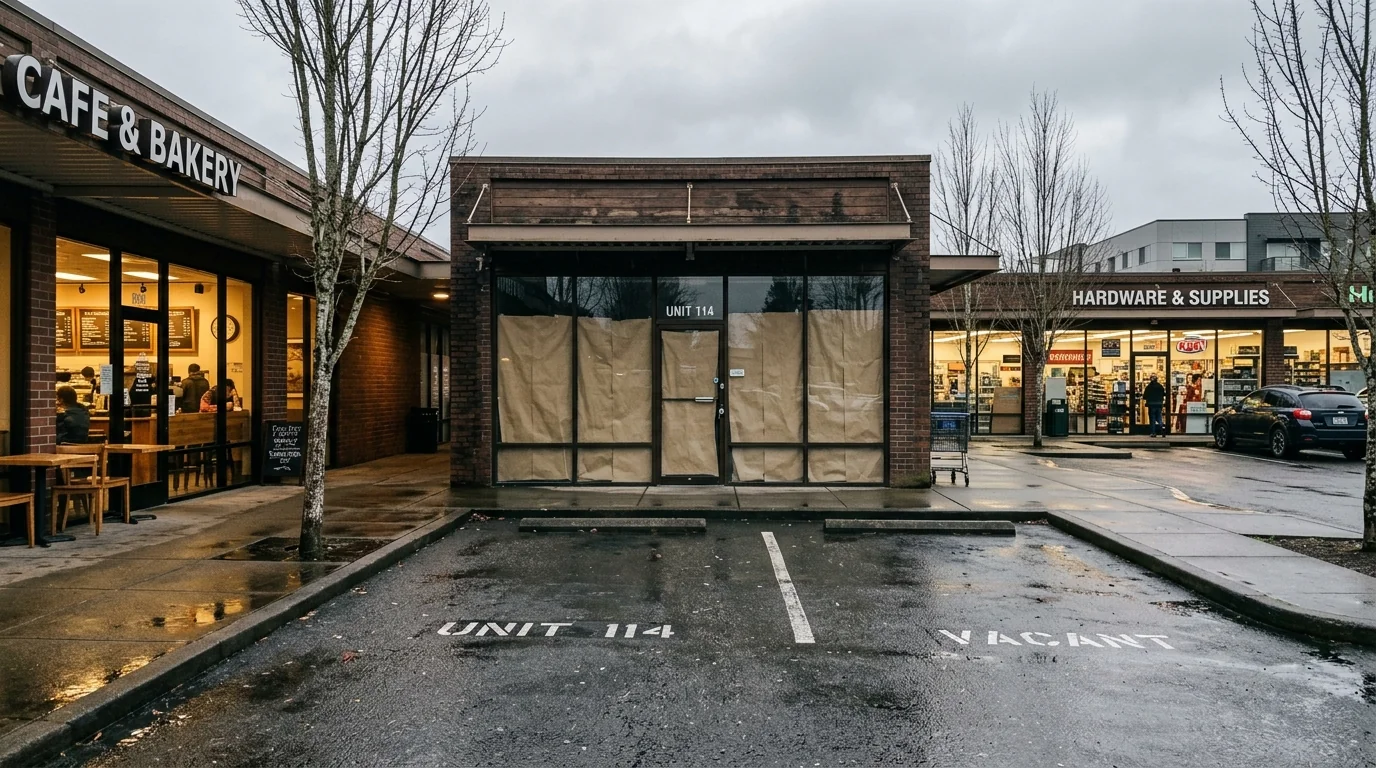
Store closures across western Washington are leaving gaps in retail corridors — and pushing more criminal activity toward the stores that remain.
The Store Closures Are Changing the Landscape
In August 2025, Kroger announced it would close six Fred Meyer and QFC stores across western Washington — including locations in Kent, Everett, Tacoma, Mill Creek, Lake City, and Redmond. The company's statement was blunt: "Due to a steady rise in theft and a challenging regulatory environment that adds significant costs, we can no longer make these stores financially viable." Kroger noted it had increased safety investment by nearly 50% and still couldn't stem the losses.
The closures are part of Kroger's nationwide plan to shutter 60 stores over 18 months. In Washington, 343 workers at just the Lake City and Redmond locations will lose their jobs.
Local officials pushed back on the theft narrative. Everett police data showed shoplifting at their Fred Meyer location actually dropped 82% over the past five years. The debate about whether theft or corporate economics is driving the closures continues. But for the communities losing their grocery stores, the cause matters less than the consequence: less access to food, fewer retail jobs, and the neighborhoods around those empty storefronts get harder to keep safe.
And Fred Meyer isn't alone. Rite Aid closed 27 Washington locations in September 2025 following its second Chapter 11 bankruptcy filing. The combined effect is that entire shopping centers across the Puget Sound are losing anchor tenants, and the remaining stores are facing higher crime pressure with fewer neighboring businesses to share the burden of security.
How Organized Retail Crime Actually Works Here
There's a common misconception that retail theft is about individuals grabbing things off shelves and walking out. That does happen, obviously. But the organized operations driving the statewide numbers work differently, and they're far more sophisticated than most people realize.
The AG's first ORC conviction tells the story. Shawn Nanez, 33, of Bremerton, hit Target stores across Kitsap, Pierce, and King counties in 28 separate thefts. He wasn't stealing for personal use. He was stealing to resell — tens of thousands of dollars' worth of merchandise. He pleaded guilty to two felony counts of first-degree organized retail theft and was sentenced to two and a half years in prison.
The AG's office later prosecuted a more elaborate scheme: three defendants who stole at least $48,878 in merchandise through a "double-dipping" operation, buying flooring and home improvement products at Home Depot, then returning to steal identical items using the original receipts. They ran this across four counties — Snohomish, Thurston, Pierce, and King.
The Pattern
Organized retail crime in western Washington tends to follow a recognizable pattern. Crews work across jurisdictions deliberately, knowing that a theft in Kent won't automatically show up on a detective's desk in Lynnwood. They target stores with known security weaknesses — limited camera coverage, inattentive loss prevention, and most critically, parking lots where they can load vehicles quickly and leave before anyone responds.
According to the King County Prosecuting Attorney's Office, the top 10% of offenders are responsible for 89% of retail theft losses. In January 2026, a single offender in western Washington generated approximately $500,000 in losses across multiple jurisdictions during a sneaker-store smash-and-grab spree. That concentration means a relatively small number of active offenders drive a disproportionate share of the damage — and they're operating as professionals.
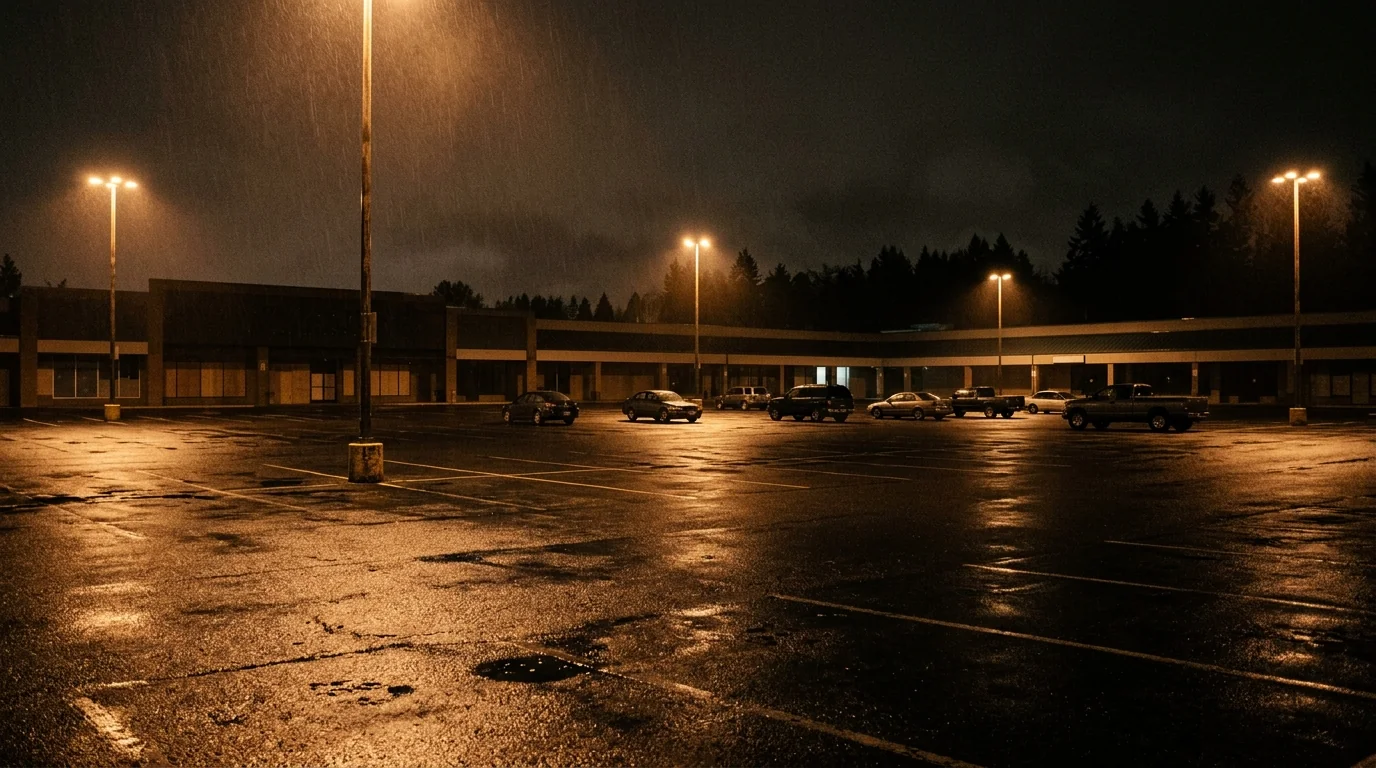
After-hours retail parking lots are staging areas for organized theft operations — crews load vehicles and leave before anyone responds.
What the State Is Doing About It
The legislative response in Olympia has been unusually active. The Seattle Metropolitan Chamber of Commerce reported that the legislature is considering 11 organized retail crime proposals in the current session, backed by a coalition including the Washington Retail Association, the Bellevue Chamber of Commerce, and Challenge Seattle.
HB 1276: Tougher Sentences for Major Thieves
House Bill 1276, sponsored by Rep. Mari Leavitt (D-University Place) and co-sponsored by Rep. Dan Griffey (R-Allyn), would add 12 months to the sentence for organized retail theft involving property worth $20,000 or more, and 24 months for $50,000 or more. Supporters testified that money from organized theft funds other criminal activity and often involves violence. The Sentencing Guidelines Commission pushed back, arguing existing aggravating factors already allow for enhanced sentencing.
Senate Bill 5060: $100 Million for Law Enforcement
SB 5060 is the largest dollar figure on the table: $100 million in grants for local governments to hire and train more law enforcement officers, roughly $50 million for public defense attorneys, and approximately $10 million specifically for retail theft prosecutors. Additional provisos extend the Attorney General's Organized Retail Crime Unit through 2027 with $1 million in dedicated funding.
King County's Proposed Task Force
At the county level, King County Councilmember Claudia Balducci proposed a permanent retail crime task force funded through new sales tax revenue. The plan calls for two King County Sheriff's Office detectives and a dedicated prosecutor from the King County Prosecuting Attorney's Office, at an estimated cost of $600,000 per year. Balducci announced the plan alongside Kent Mayor Dana Ralph and former Sheriff Sue Rahr, directly in response to the Fred Meyer closures.
Whether these measures will reverse the trend remains to be seen. But the volume of legislative activity makes one thing clear: the state has acknowledged this is a crisis, not a blip.
The AG's ORC Unit: Real Prosecutions, Real Sentences
The Attorney General's Organized Retail Crime Task Force, established in 2022, has moved from investigation to prosecution. The first conviction resulted in 2.5 years of prison time. The unit has filed at least six prosecutions since its creation, targeting operations that span multiple counties. Additional funding of $39 million has been allocated for recovery navigator programs in Snohomish, King, and Pierce counties — a recognition that organized theft networks are operating at scale across the region.
What the Closures Mean for the Stores That Stay
When an anchor store closes in a shopping center, the security problem doesn't leave with it. In many cases, it gets worse. The vacant storefront becomes a magnet for loitering, vandalism, and break-ins. Foot traffic drops, which means fewer eyes on the property. Other tenants see their own theft rates climb as the criminals who were spreading across multiple stores now concentrate on fewer targets.
We've seen this pattern play out across the Tacoma-Seattle corridor. A Fred Meyer or Rite Aid closes, and within months the remaining retailers in that center are calling about increased incidents in their parking lots and loading areas. The shopping center landlord is often caught in the middle — losing rental income from the closed store while facing pressure from remaining tenants to do more about security.
For standalone retailers and smaller strip malls, the math is even harder. A single store doesn't have the loss prevention budget of a national chain. A single bad month of organized theft can wipe out a quarter's profit margin. And for a business that's already dealing with higher insurance premiums, staff shortages, and tight margins, the path from "managing a theft problem" to "considering closing the store" is shorter than most people think.
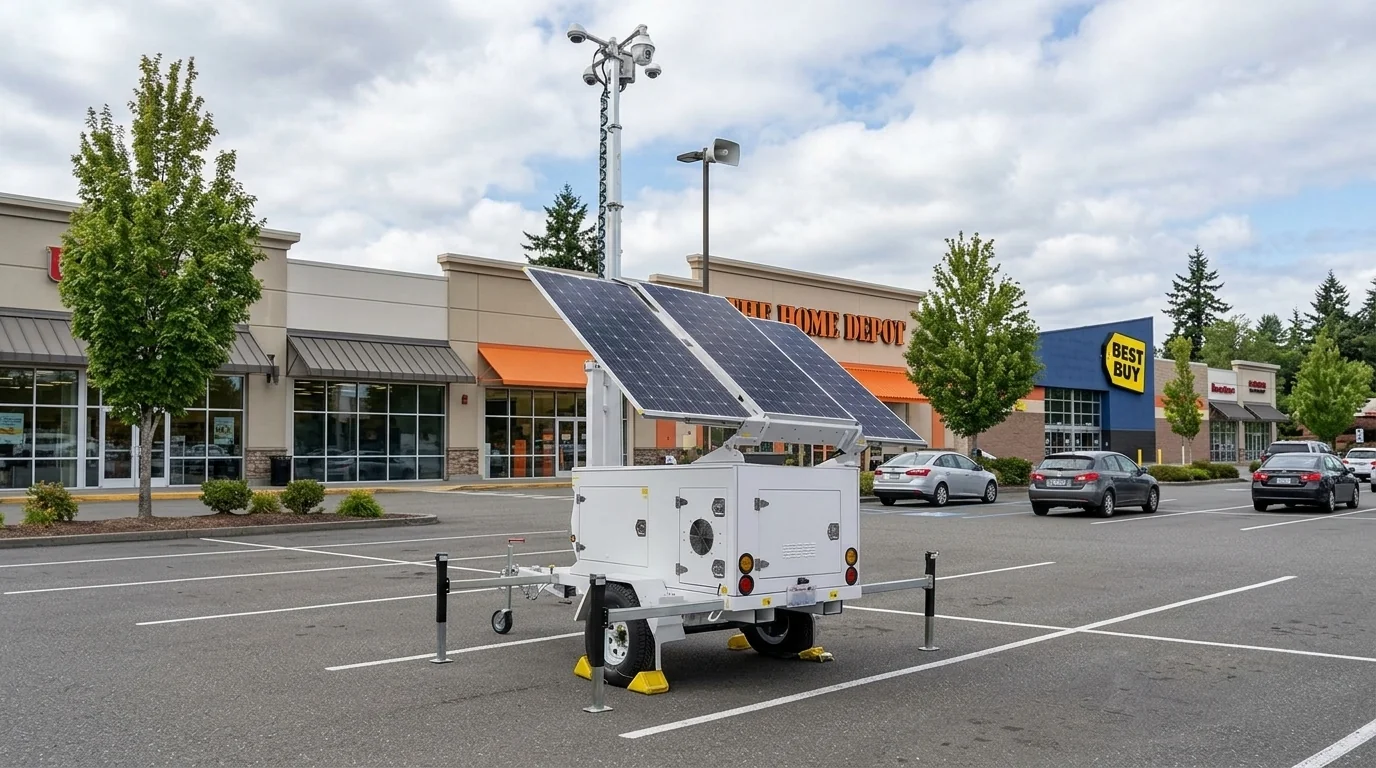
A mobile surveillance trailer in a retail parking lot — the elevated camera position and visible presence deter organized theft crews who prefer unmonitored targets.
Where Parking Lot Security Fits In
Retail theft doesn't just happen inside the store. The parking lot is where organized crews stage vehicles, transfer merchandise, watch for loss prevention activity, and make their exit. The Office of Justice Programs published a 40-year meta-analysis of CCTV effectiveness and found the strongest results in parking lots: a 51% reduction in crime where surveillance was deployed. That's substantially better than the 10% reduction observed in town centers and other settings.
The reasons are straightforward. Parking lots are bounded spaces with limited entry and exit points. Cameras can cover large areas from elevated positions. And the people committing organized retail theft — unlike opportunistic shoplifters — are making calculated decisions about risk. They drive by a property, assess the security posture, and pick the path of least resistance. A visible surveillance presence is often enough to send them somewhere else.
Why Fixed Cameras Often Fall Short
Many shopping centers have security cameras. Usually they're mounted under eaves at 10 to 12 feet, covering the entrances and a portion of the nearest parking rows. They record to an NVR in a back office that nobody monitors in real time. After a theft, somebody pulls the footage, discovers the camera angle doesn't quite capture the license plate, and files it with a police report that goes into a backlog. Sound familiar?
The issue isn't that fixed cameras are useless. They serve a purpose for entrances, POS areas, and interior coverage. But for the parking lot — where the organized activity actually stages and escapes — a camera mounted at storefront height with a fixed angle is watching a fraction of what matters. The merchandise is already out the door by the time it enters frame.
What Makes Mobile Surveillance Different
A mobile surveillance trailer parked in a retail lot operates at 20+ feet of elevation with 360-degree PTZ coverage. One unit sees the entire parking area that would require eight or more fixed cameras to cover. It runs on solar power, connects over cellular networks, and can't be taken offline by cutting a wire. AI-powered motion detection distinguishes people from vehicles from animals, and sends real-time alerts when activity matches suspicious patterns.
More importantly, it's visible. A 20-foot camera tower with indicator lights is not something you miss from the road. For the organized crews doing their pre-theft reconnaissance, it's a clear signal that this property has active monitoring — and they move on to one that doesn't. Over 50% of burglars report avoiding properties with visible cameras entirely, according to Security Magazine research.
A Practical Security Framework for Retail Properties
Whether you're a shopping center landlord, a standalone retailer, or a property management company overseeing multiple retail locations, here's what we've seen work across the Puget Sound.
Parking Lot and Perimeter
- Elevated surveillance covering the full parking area, not just the store entrances. The staging area for organized theft is the lot itself.
- License plate recognition at entry and exit points. Organized crews use the same vehicles repeatedly — LPR builds a pattern that individual incidents don't reveal.
- Adequate lighting across the entire lot, including back rows and areas adjacent to vacant storefronts. LED floodlights are one of the cheapest and most effective deterrents.
- Clear sightlines — remove landscaping that creates blind spots between the lot and the street.
Active Monitoring
- Real-time alerts, not just recording. Someone needs to know within seconds when suspicious activity occurs, not the next morning when reviewing footage.
- Two-way audio capability for immediate verbal intervention. Most incidents end the moment a person realizes they're being watched.
- Cellular-connected systems that transmit footage off-site immediately. On-site NVRs can be tampered with; footage that's already in the cloud can't be destroyed.
Coordination
- Report every incident. Jurisdictional fragmentation across King and Pierce counties means the pattern connecting your property to three others only becomes visible if everyone reports.
- Share information with neighboring businesses. Organized crews hit clusters — if they're at the strip mall down the street, they're probably scouting yours.
- Engage with the AG's Organized Retail Crime Task Force for incidents involving multi-county or multi-store operations.
The Insurance Angle
Documented surveillance coverage — especially with timestamped, AI-tagged footage — can reduce commercial property insurance premiums by 15-20%. But the bigger benefit is in claims. Retail theft and property damage claims without video evidence are slow, contentious, and frequently underpaid. With clear footage showing exactly what happened and when, claims get processed faster and coverage disputes are rare. For multi-tenant shopping centers, offering surveillance as part of the common area security often factors into lease negotiations with prospective tenants.
The Bottom Line
Washington state has a retail theft problem that's worse than anywhere else in the country by at least one major measure. The legislative response is the most aggressive the state has seen — 11 bills, $100 million in proposed funding, a dedicated ORC unit with real prosecutions. But legislation takes time, and stores are closing now. The communities losing Fred Meyers and Rite Aids aren't going to get them back by waiting for a task force to stand up.
What retail property owners can control is their own security posture. The research is clear that visible surveillance in parking lots reduces crime by up to 51%. The organized crews driving the biggest losses are making calculated decisions about which properties to hit — and they consistently choose the ones with the fewest visible security measures. Making your property harder than the one down the road is, practically speaking, one of the most effective things you can do right now.
We've been deploying mobile surveillance at retail properties, shopping centers, and commercial lots across the Puget Sound since 2009. Our trailers are solar powered, cellular connected, and equipped with AI-powered detection and two-way audio. If you're a property owner or retailer dealing with increased theft activity and you're not sure whether your current security is covering the gaps, we'll do a free site assessment. Get in touch or call us at (253) 683-2288.
About CCTV Trailer
CCTV Trailer provides mobile surveillance solutions across the Puget Sound region, headquartered in Tacoma with same-day deployment capability throughout Pierce County and King County. Our solar-powered trailers feature PTZ cameras with AI-powered analytics, 4G/5G connectivity for live remote monitoring, and elevated camera positions for maximum coverage area.
We work with retail property owners, shopping center landlords, construction companies, and businesses to provide flexible, effective surveillance coverage without the cost and timeline of permanent camera installations. Learn more about our team and technology.
Need Security for Your Retail Property?
Get mobile surveillance coverage for your shopping center, retail lot, or commercial property — deployed within 24 hours, no infrastructure required.
✓ Same-Day Deployment ✓ Solar Powered — No Grid Needed ✓ 51% Crime Reduction in Parking Lots
Related Resources
Retail Parking Lot Security
Mobile surveillance solutions for retail centers, shopping plazas, and commercial parking lots across Tacoma and the Puget Sound.
Learn more →Same-Day Security Rental
Emergency surveillance deployment for retail properties, shopping centers, and commercial facilities needing immediate security coverage.
Learn more →Cargo Theft Along the I-5 Corridor
How organized theft is targeting warehouses and distribution centers along the same I-5 corridor where retail crime is surging.
Learn more →Vandalism Prevention Solutions
24/7 surveillance to prevent vandalism at retail properties, parking structures, and commercial buildings.
Learn more →Security Trailer vs Guards
Cost comparison between mobile surveillance trailers and traditional security guard services for retail properties.
Learn more →Tacoma Public Space Safety
What the crime data shows for public spaces in Tacoma — and the role of visible surveillance in deterring property crime.
Learn more →Auto Dealer Lot Security
How Pierce and King County dealerships protect inventory from the same organized crews driving retail theft.
Learn more →