Cargo Theft Along the I-5 Corridor: Why Fife, Kent, and Tacoma Warehouses Keep Getting Hit
The stretch of Interstate 5 between Tacoma and Seattle moves more freight than almost any corridor on the West Coast. It's also one of the easiest places in the country to steal it. National cargo theft losses surged 60% to $725 million in 2025. Washington ranks fifth worst nationally. And the cities that sit right along this corridor — Fife, Tukwila, Kent, Tacoma — have some of the highest property crime rates in the state. Here's what's actually happening, and what warehouse and distribution center operators can do about it.
Quick Answer
How bad is cargo theft in the Seattle-Tacoma I-5 corridor?
National cargo theft losses reached $725 million in 2025, a 60% increase over 2024, with the average theft now worth $274,000. Washington ranks 5th nationally for cargo theft. Fife, WA — sitting directly on the I-5 between Tacoma and Seattle — is the most dangerous city in the state with a property crime rate of 9,857 per 100,000. Nearby Tukwila has the highest property crime rate in Washington at over 18,000 per 100,000. The Kent Valley warehouse district, the 4th largest in the U.S., has seen organized theft rings operating across the corridor. Mobile surveillance trailers provide 24/7 yard and perimeter coverage for warehouses, distribution centers, and freight yards without requiring permanent infrastructure or long-term guard contracts.
The Geography of the Problem
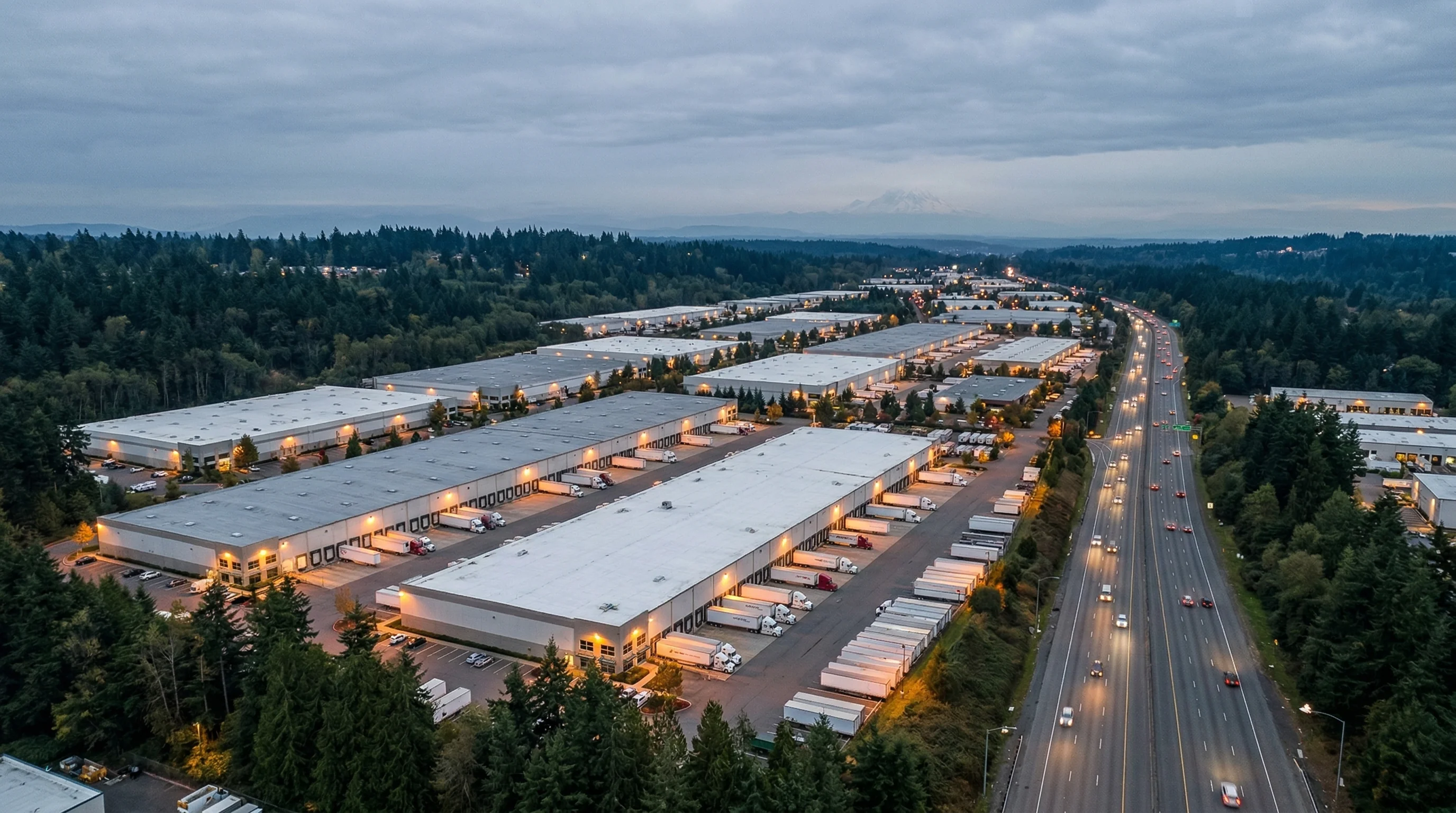
If you were designing a corridor to attract cargo theft, you'd build something that looks a lot like the I-5 stretch between Tacoma and Seattle. You'd pack it with distribution centers, freight yards, and cross-dock facilities. You'd give it fast highway access in multiple directions. You'd surround it with cities that don't have enough police officers to keep up with call volume. And you'd make sure there were plenty of truck stops, budget motels, and anonymous industrial parks where stolen goods can change hands quickly.
That's what we have. The Kent Valley alone is the fourth-largest warehouse and distribution district in the United States. Amazon, FedEx, UPS, Costco, REI, and dozens of smaller logistics operators all run facilities within a few miles of each other along the Green River Valley floor. It's the heart of freight movement for the Pacific Northwest.
Directly south on I-5, Fife sits at the junction between the port corridor and the highway. It's a small city — about 10,000 people — but it ranks as the most dangerous city in Washington state for 2026. The property crime rate runs between 9,857 and 12,147 per 100,000 residents, putting it in the worst 10% of all American cities. Residents have roughly a 1-in-9 chance of being a property crime victim in any given year. The city's own geography works against it: freight lines, busy highway ramps, and a shortage of street lighting create conditions where theft operations can move fast and disappear faster.
Then there's Tukwila, wedged between Kent and Seattle, home to Southcenter Mall and acres of commercial real estate. Tukwila holds the highest property crime rate in Washington — over 18,000 per 100,000, which is 923% higher than the national average. Vehicle thefts rose 57.6% recently, and organized retail theft rings use the area as a base for operations spanning multiple counties.
Tacoma rounds out the corridor with a property crime rate of 7,353 per 100,000 and 2,921 vehicles stolen annually. Older industrial districts with underutilized warehouses concentrate criminal activity in exactly the areas where legitimate logistics operations are running.
These aren't isolated problems in separate cities. They're all connected by the same highway, the same freight routes, and in many cases the same theft networks operating across jurisdictions.
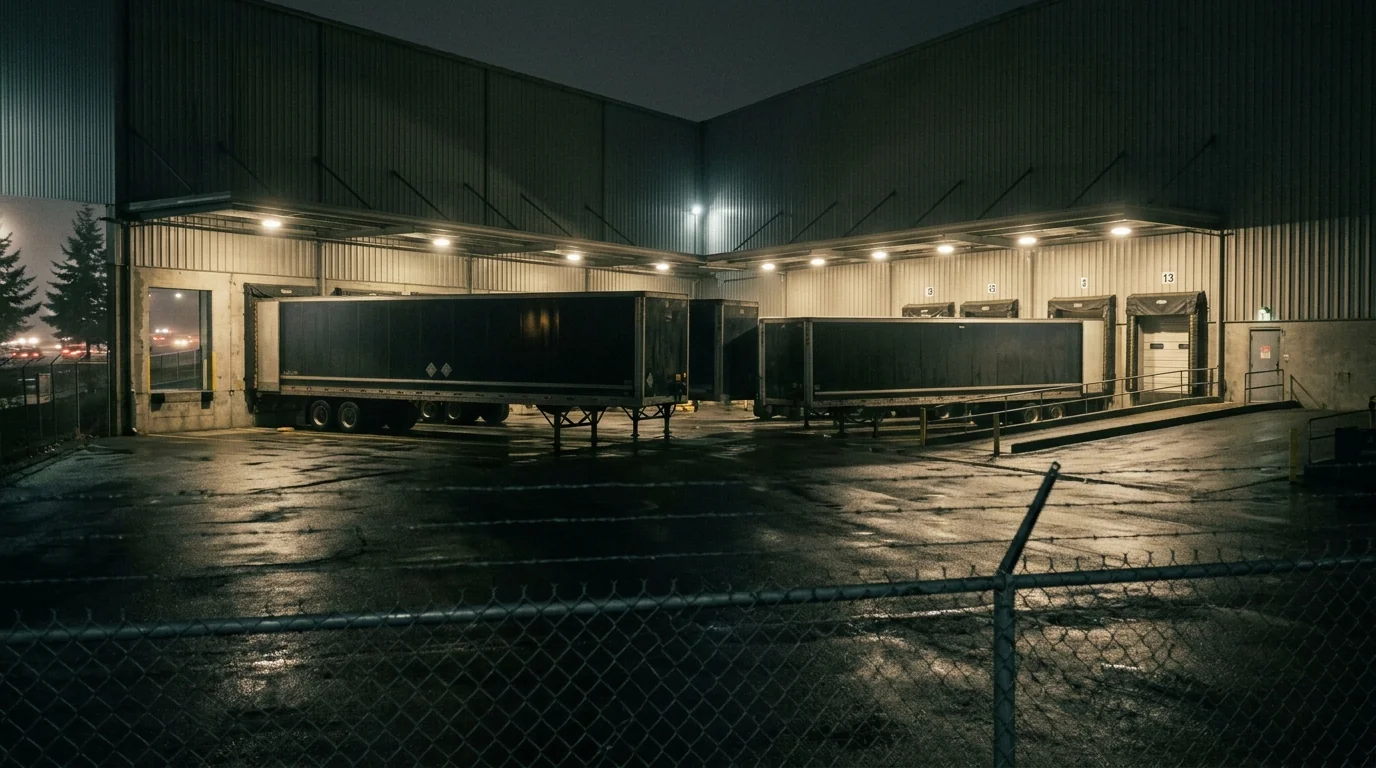
Freight trailers and loading docks in an I-5 corridor warehouse yard after hours — the window when most cargo theft occurs along this stretch.
The Numbers: Cargo Theft Is Getting Worse, Not Better
The national picture is stark. CargoNet's 2025 annual report counted 3,594 supply chain crime events across the U.S. and Canada, with confirmed cargo theft incidents rising 18% year-over-year to 2,646. But the real story is in the dollar figures: estimated losses hit $725 million, a 60% jump from 2024. The average value per theft climbed 36% to $273,990. Thieves aren't just stealing more often — they're stealing bigger.
Overhaul's parallel analysis counted 2,576 cargo thefts in the U.S. — a 16% increase, averaging 7.16 thefts per day, up from 6.07 the year before. Their projection for 2026 is another 13% increase, pushing toward 2,910 incidents. Q4 was the worst quarter, accounting for 30% of the annual total.
The National Insurance Crime Bureau ranks Washington in the top five states for cargo theft impact. California and Texas dominate the national statistics, accounting for 58% of all incidents. But Washington's position at fifth nationally is disproportionate to its population and reflects how concentrated the problem is along the I-5 and around the Ports of Seattle and Tacoma.
One category that's exploded: metal theft, up 77% in 2025. That tracks with what we've been seeing locally with copper theft at construction sites across the corridor. Food and beverage thefts jumped 47% to 708 incidents — a category that hits distribution centers and cold storage facilities particularly hard.
The FBI's Bigger Number
The FBI tracked 5,715 commercial cargo theft instances in 2024 with property losses totaling $155.6 million in reported value. But industry analysts estimate the true annual cost — including unreported theft, investigation costs, supply chain disruption, and insurance impacts — at roughly $35 billion. Most cargo theft goes unreported because companies fear reputational damage, insurance premium increases, or simply lack the evidence to file a meaningful police report.
What's Happened Here: Incidents Along the I-5 Corridor
The data tells one story. The incidents tell another. Here are some of the ones that made the news.
The $1.4 Million Nintendo Heist
In June 2025, a semi-truck carrying 2,810 Nintendo Switch 2 consoles — worth a combined $1.4 million — was stolen en route from Nintendo of America's headquarters in Redmond, WA. The trailer was discovered at a truck stop in Colorado. The investigation pointed to possible inside involvement. The consoles hadn't even been released to the public yet.
The Sumner Yard Raid
In one of the largest documented thefts in the state, a crew hit a freight yard in Sumner — just south of Fife — cutting CCTV cables before systematically searching nine parked trailers. They drove off with four of them, containing $1.35 million in laptops and electronics. It was the first recorded multi-trailer theft in Washington, and it demonstrated a level of planning and logistics expertise that pointed straight to organized crime.
The Kent-Auburn Cluster
Over a single August-to-September period, the Kent and Auburn area saw nine trailer and container thefts attributed to an organized crime group with ties to Southern California. The pattern was consistent: target yards with poor lighting and no active monitoring, breach the perimeter after midnight, and be on the highway before anyone notices in the morning.
$62,000 Storage Facility Burglary in Puyallup
In March 2025, thieves hit a Puyallup storage facility and made off with 60 firearms and art worth $62,000. The Pierce County Sheriff's Office turned to Crime Stoppers for public help identifying the suspects. Storage facilities along this corridor face the same vulnerability as warehouses: high-value contents behind minimal overnight security.
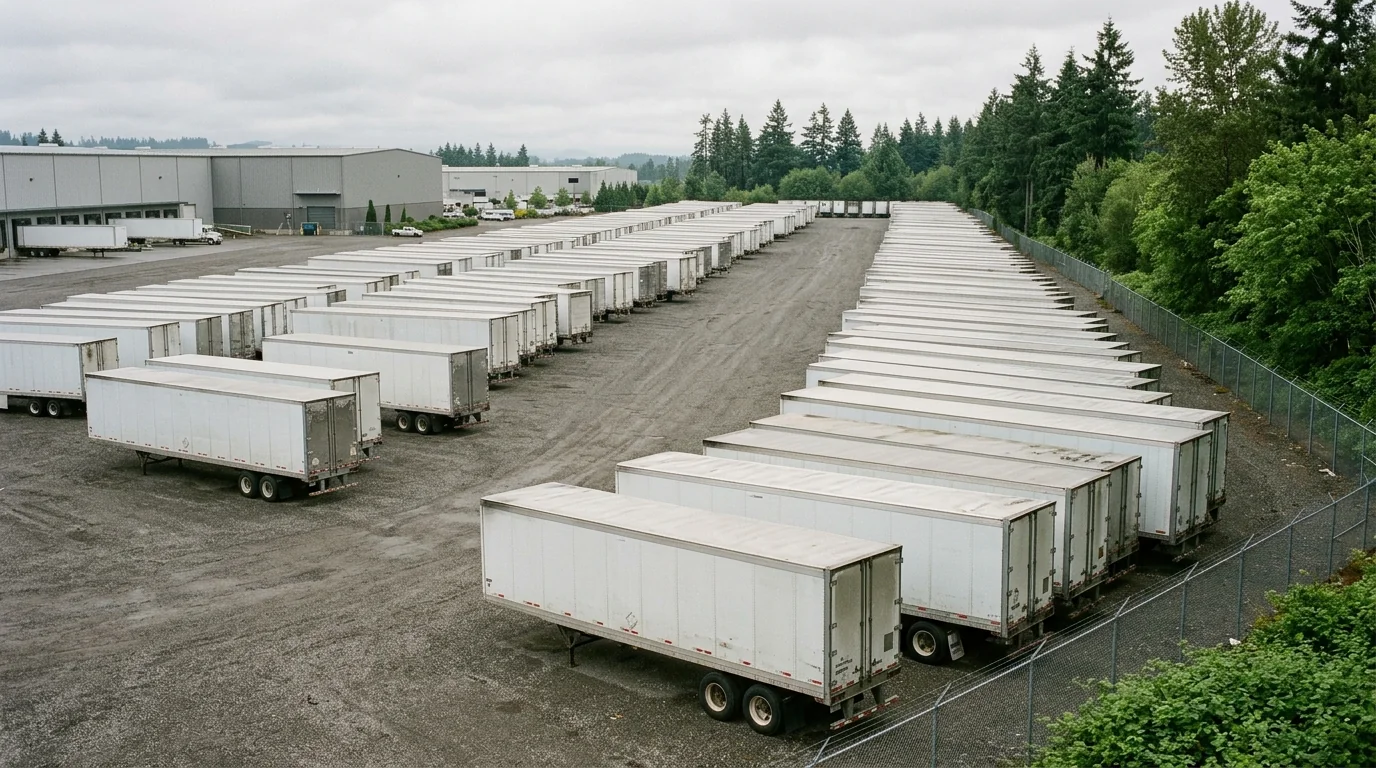
Unattended freight trailers at a distribution center in the Kent Valley — organized theft crews target yards like these during overnight hours when staffing drops.
How They're Doing It: The Methods Are Getting Smarter
The days of a guy with bolt cutters and a pickup truck aren't over, but they're no longer the main concern. Strategic theft methods have grown roughly 1,500% since 2022, according to Willis Towers Watson's analysis of supply chain crime.
Fictitious Pickups
The fastest-growing method. Criminal organizations create fake carrier identities, forge documentation, and show up at distribution centers to collect loads under false pretenses. Fictitious pickups climbed from an average of 66 incidents per year (2012-2022) to 576 in 2023, and they've continued climbing. Deceptive pickup incidents now represent 10% of all recorded cargo theft events. The documentation looks legitimate. The drivers have valid CDLs. The only thing that catches them is verification protocols that most facilities don't have.
Yard Shopping
The Sumner heist demonstrated this technique perfectly. Crews enter freight yards after hours, move through parked trailers testing locks and opening doors until they find high-value loads, then drive out with the trailers themselves. The Sumner crew searched nine trailers before selecting four. That kind of methodical operation takes time — time they had because nobody was watching.
Inside Coordination
The Nintendo theft and similar high-profile cases increasingly point to inside information. Someone knows what's in the trailer, when it's moving, and what the security gaps look like. The FBI has flagged inside coordination as a growing element of organized cargo theft, particularly for loads targeting specific high-value consumer electronics and pharmaceuticals.
Cable Cutting
Before the Sumner theft, the crew cut the CCTV cables. It's a common first move. Fixed camera systems that rely on hardwired connections to a central recorder are vulnerable to a pair of snips. Once the cameras are dead, the operation proceeds without a visual record. This is also why we're seeing more interest in wireless, cellular-connected surveillance systems that don't have cables to cut.
The Organized Crime Dimension
This isn't petty theft. The Kent-Auburn cluster was attributed to a group with ties to Southern California. Organized retail theft rings operating out of Tukwila and Lynnwood have connections spanning multiple counties and states. Washington's Attorney General extended the Organized Retail Crime Task Force through 2027 with $1 million in state funding, and allocated an additional $39 million for recovery navigator programs in Snohomish, King, and Pierce counties. These aren't resources you deploy for shoplifters — they're the state's acknowledgment that organized theft networks are operating at scale in this region.
Why Warehouses Along This Corridor Are Especially Vulnerable
There's a reason thieves keep coming back to the same stretch of highway. The I-5 corridor between Tacoma and Seattle has a combination of factors that make it uniquely attractive for cargo theft operations.
Density Without Proportional Security
The Kent Valley alone has hundreds of warehouse and distribution facilities packed into a relatively small area. Many of these are leased spaces operated by third-party logistics providers with thin margins and minimal security budgets. A fence, a gate, maybe some fixed cameras watching the loading dock — that's the typical setup. The yards where trailers sit overnight are often outside the camera coverage area entirely.
Highway Access Works Both Ways
The same I-5 on-ramps that make this corridor efficient for freight movement also make it efficient for theft. A crew can be on the highway within minutes of leaving a yard, heading north toward Seattle, south toward Olympia, or east on SR-167 toward Auburn. By the time anyone notices a trailer is missing in the morning, it could be 200 miles away.
Jurisdictional Fragmentation
Drive 15 miles on I-5 from Tacoma to Tukwila and you'll cross through multiple police jurisdictions: Tacoma PD, Fife PD, Federal Way PD, Kent PD, Tukwila PD, plus the Pierce and King County Sheriff's offices and Washington State Patrol. Each has its own dispatch, its own case numbers, and its own property crime backlog. Organized crews know that stealing in one jurisdiction and fencing goods in another makes investigation significantly harder.
Overnight Staffing Gaps
Most warehouse operations run two shifts: a day shift and a swing shift that ends between 10 PM and midnight. Between midnight and 6 AM, many facilities have nobody on-site. Even facilities with 24-hour operations typically have skeleton crews focused on their work, not watching the perimeter. The Overhaul data shows 21% of cargo theft incidents occur at truck stops and fuel stations, but a comparable share happens at yards, cross-docks, and unsecured parking areas — exactly the kind of facilities that line this corridor.
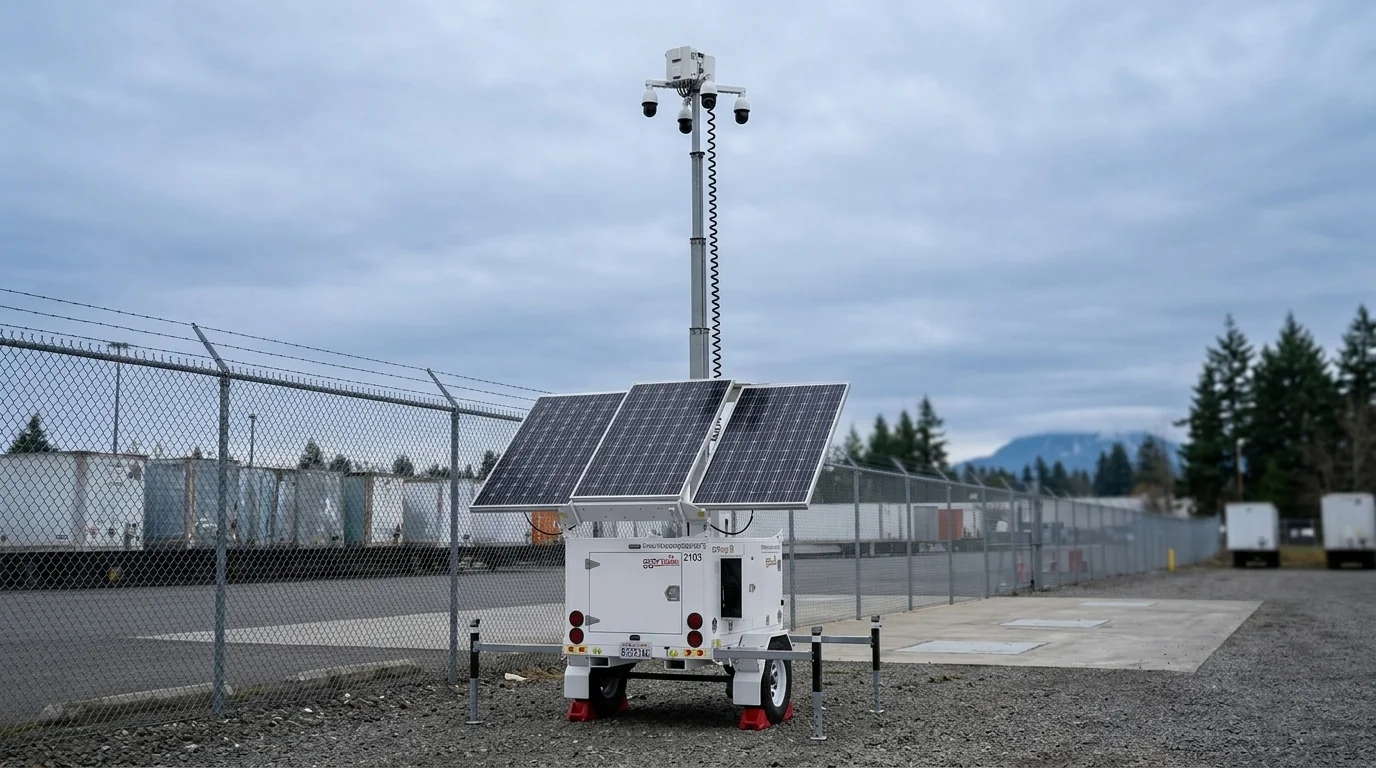
A mobile surveillance trailer deployed at a warehouse facility — solar powered with cellular connectivity, providing elevated 360-degree coverage that can't be disabled by cutting cables.
What Actually Works: Securing a Warehouse Yard in 2026
We've been deploying mobile surveillance at industrial sites and warehouse facilities across this corridor since 2009. Here's what we've learned about what works and what doesn't.
Fixed Cameras Alone Aren't Enough
The Sumner crew cut the cables first. That's not unusual — it's standard procedure for organized theft operations. Fixed camera systems that connect via cable to an on-site NVR have a single point of failure. If your security depends entirely on cameras that can be defeated with wire cutters, you don't really have security. You have a recording system that works until someone decides it shouldn't.
That doesn't mean fixed cameras are useless. Loading dock cameras, interior cameras, and access point cameras all serve important functions. But for yard security and perimeter coverage — the areas where the actual theft happens — you need something that can't be cut off by snipping a wire.
Cellular Connectivity and Onboard Storage
Mobile surveillance units that transmit video over 4G/5G cellular networks and store footage on the unit itself eliminate the cable-cutting vulnerability. Even if someone tampers with the unit (which is significantly harder when it's a locked, armored trailer on an elevated mast), the footage has already been transmitted off-site. You can't destroy evidence that's already in the cloud.
Elevated Camera Position
Most fixed warehouse cameras are mounted at 8 to 12 feet — loading dock height. At that level, a camera sees what's directly in front of it. A mobile surveillance trailer with cameras at 20+ feet sees the entire yard. That elevation difference is the difference between watching one aisle and watching the whole facility. For a warehouse yard with 30 or 40 parked trailers, one elevated camera platform replaces what would require six to eight fixed cameras to achieve similar coverage.
AI-Powered Motion Detection
A camera that records 24/7 and stores footage for someone to review after the fact is an evidence tool, not a prevention tool. AI-powered detection systems that can distinguish between a person, a vehicle, and an animal — and send a real-time alert to a monitoring station or directly to your phone — turn surveillance from passive recording into active deterrence. When a person enters the yard at 2 AM and a two-way audio speaker immediately challenges them, most threats end right there.
Visible Deterrence
There's a reason the organized crews doing "yard shopping" target facilities with poor lighting and no visible security presence. A 20-foot camera trailer with flashing indicator lights sitting in your yard is not subtle. That's the point. The vast majority of cargo theft is opportunistic — the crew drives by, assesses the security posture, and picks the easiest target. Making your facility look harder than the one down the street is, by itself, one of the most effective things you can do.
The Cost Equation for Warehouse Operators
The math on warehouse security is different from construction or events because the risk is ongoing. A construction site has a defined timeline. An event runs for a weekend. But a warehouse yard is exposed every single night.
Security Guards
A single overnight security guard (10 PM to 6 AM) at current Pacific Northwest rates runs roughly $360 to $520 per night ($45-65/hour x 8 hours). For a 5-night work week, that's $1,800 to $2,600 per week, or $7,200 to $10,400 per month. One guard can patrol, but they can't watch the entire yard simultaneously. If your yard has multiple access points or covers more than a few acres, a single guard on foot has significant blind spots.
Mobile Surveillance
A mobile surveillance trailer provides continuous 360-degree monitoring, 24 hours a day, with AI-powered alerts, for a fraction of the guard cost. Monthly deployments typically run 60-75% less than equivalent guard coverage. The trailer doesn't take breaks, doesn't call in sick, doesn't have blind spots when it's facing the other direction, and provides court-admissible video evidence for every incident.
Insurance Implications
Documented surveillance coverage can reduce insurance premiums by 15-20% — and more importantly, it gives your insurer what they need to process a claim efficiently if theft does occur. Without video evidence, cargo theft claims are notoriously difficult. With timestamped, AI-tagged footage showing exactly what happened and when, claims move faster and coverage disputes are rare.
Consider what a single cargo theft costs. The national average in 2025 was $274,000. Even if the odds of your specific facility getting hit in any given year are low, the financial impact of one successful theft dwarfs the annual cost of surveillance coverage multiple times over.
New Washington Law: Senate Bill 6002 and ALPR Regulations
In March 2026, Washington passed Senate Bill 6002 (the Driver Privacy Act), regulating automated license plate readers for the first time. The law applies to state and local government agencies: it limits their LPR data retention to 21 days, confines police use to stolen vehicles, missing or endangered persons, outstanding felony or gross misdemeanor warrants, and vehicles tied to felonies or gross misdemeanors, and requires 2-year audit trails for all data access. Private warehouse operators aren't directly regulated, but agencies can now obtain privately held LPR data only with a court-issued warrant. We break down what that means for private sites in our 2026 guide to Washington security camera laws. The bill was sponsored by Senator Yasmin Trudeau of Tacoma.
A Security Framework for I-5 Corridor Warehouses
No single measure stops organized cargo theft. But a layered approach dramatically reduces your exposure. Based on what we've seen work at industrial sites across the corridor, here's a framework.
Perimeter and Access
- Fence integrity checks — monthly at minimum. Organized crews often pre-stage breaches (cutting fence sections that are then loosely reattached) days before the actual theft.
- Gate access logging with camera coverage at every entry and exit point
- Adequate lighting across the entire yard, not just near the building. LED floodlights on the fence line cost a fraction of what a single theft costs.
- Eliminate blind spots behind buildings, between container rows, and along fence lines adjacent to roads
Active Monitoring
- Elevated surveillance covering the entire trailer yard, not just the loading docks
- Cellular-connected cameras that can't be defeated by cable cutting
- AI motion detection with real-time alerts — someone should know within seconds when a person enters the yard after hours
- Two-way audio capability for immediate verbal intervention
- License plate recognition at all vehicle access points
Operational Protocols
- Carrier verification for every pickup — check the MC number, call the shipper, confirm the load assignment. Fictitious pickups succeed because nobody checks.
- High-value trailer positioning: park your most valuable loads closest to the building and camera coverage, not at the back of the yard
- Seal and lock protocols: use tamper-evident seals on all outbound trailers and record seal numbers
- Report every incident, even minor ones. Jurisdictional fragmentation means that the pattern connecting your yard to three other facilities might only become visible if everyone is reporting.
The Bottom Line
The I-5 corridor between Tacoma and Seattle handles a staggering volume of freight, and it's surrounded by cities with some of the highest property crime rates in the state. Fife is the most dangerous city in Washington. Tukwila has the highest property crime rate. Kent Valley is the fourth-largest warehouse district in the country. Cargo theft nationally hit $725 million in 2025 and is projected to keep climbing.
The facilities that don't get hit consistently are the ones that make themselves harder targets. That means visible, active surveillance — not just cameras pointed at the loading dock that nobody monitors until after the loss. It means cellular-connected systems that can't be taken offline with wire cutters. It means real-time detection and alerts, not footage you review the next morning when the trailers are already gone.
We've been deploying mobile surveillance at warehouses, freight yards, and distribution centers across this corridor for over 15 years. Our trailers are solar powered (no need to run power to the yard), cellular connected (no cables to cut), and equipped with AI-powered detection that sends alerts the moment someone enters your yard after hours. If you're operating along this corridor and you're not sure whether your current security covers the gaps, we'll do a free site walkthrough and show you what we'd recommend. Get in touch or call us at (253) 683-2288.
About CCTV Trailer
CCTV Trailer provides mobile surveillance solutions across the Puget Sound region, headquartered in Tacoma with same-day deployment capability throughout Pierce County and King County. Our solar-powered trailers feature PTZ cameras with AI-powered analytics, 4G/5G connectivity for live remote monitoring, and elevated camera positions for maximum coverage area.
We work with warehouse operators, distribution centers, construction companies, and businesses to provide flexible, effective surveillance coverage without the cost and timeline of permanent camera installations. Learn more about our team and technology.
Need Security for Your Warehouse or Yard?
Get mobile surveillance coverage for your distribution center, freight yard, or warehouse facility — deployed within 24 hours, no infrastructure required.
✓ Same-Day Deployment ✓ Solar Powered — No Grid Needed ✓ Cellular Connected — No Cables to Cut
Related Resources
Construction Site Security
Mobile surveillance for construction projects, equipment yards, and staging areas throughout the Puget Sound.
Learn more →Same-Day Security Rental
Emergency surveillance deployment for warehouses, yards, and facilities needing rapid security coverage.
Learn more →Equipment Theft Prevention
Protect high-value equipment, inventory, and materials from organized theft operations.
Learn more →Vandalism Prevention Solutions
24/7 surveillance to prevent vandalism at facilities, yards, and commercial properties.
Learn more →Security Trailer vs Guards
Cost comparison between mobile surveillance trailers and traditional security guard services.
Learn more →Copper Theft at Construction Sites
How copper theft is surging across the Tacoma-Seattle corridor and what contractors are doing about it.
Learn more →Washington Retail Theft Crisis
The same organized rings hitting I-5 warehouses are driving Washington's retail theft crisis.
Learn more →Auto Dealer Lot Security
Dealer lots along I-5 are a popular follow-on target for cargo theft crews — here's how lots respond.
Learn more →