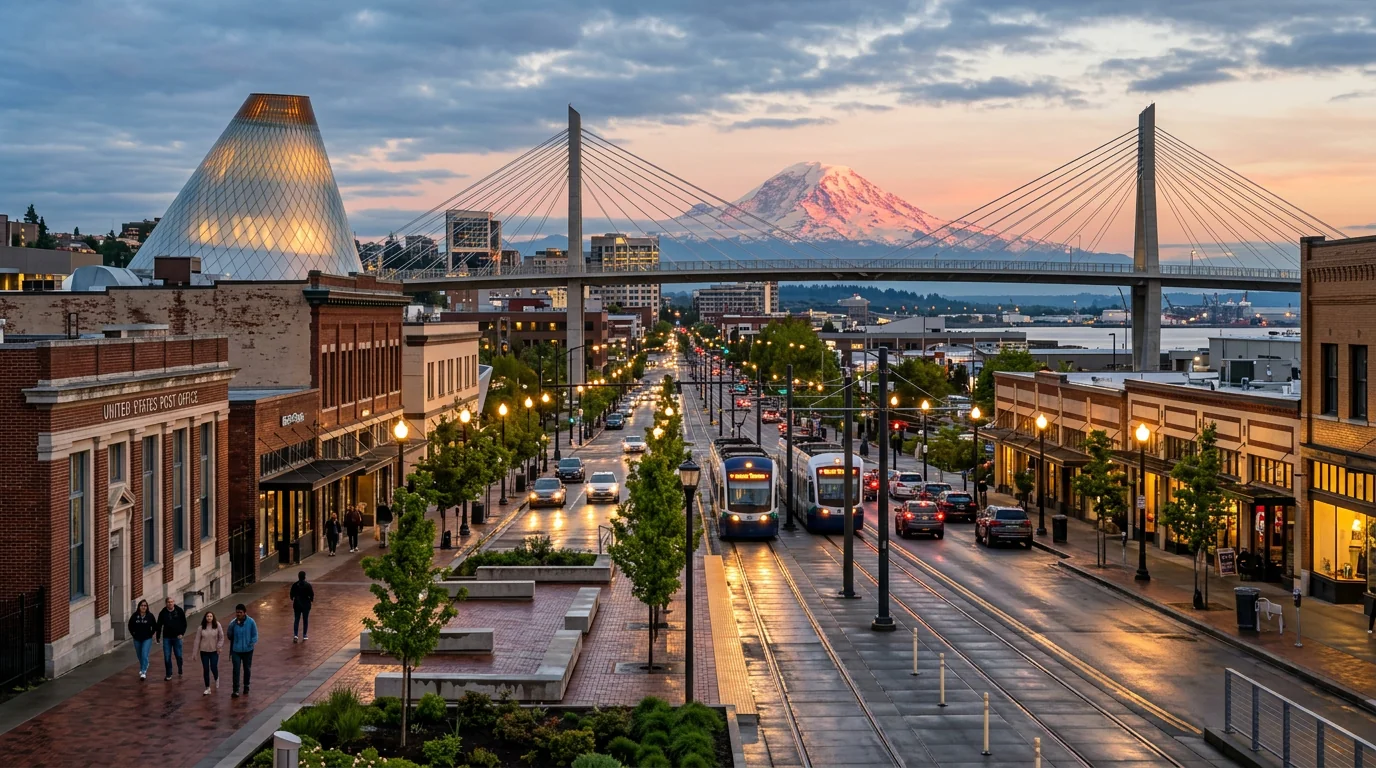
Tacoma's Public Space Safety Problem: What the Numbers Actually Show
Tacoma cut violent crime by 17% in 2024. That's real progress. But business owners along East 25th Street and people who walk Point Defiance Park after dark tell a different story. Only 24% of residents say they feel safe in downtown Tacoma. Here's what's actually happening on the ground and where the biggest gaps are.
Quick Answer
How safe are Tacoma's public spaces in 2025-2026?
Tacoma recorded 22,230 total crimes in 2024. While overall violent crime dropped 17.3% in 2024, specific public spaces remain problem areas. Point Defiance Park experienced 5 assaults and 1 sexual assault in 2024. South Park suffered $400,000 in vandalism damage. Only 24% of residents feel safe downtown. The city's Violent Crime Reduction Plan - developed with UT San Antonio researchers - produced a 13% drop in violent crime in hot-spot patrol areas and a 19% drop in the surrounding zones, and the city is now expanding surveillance camera authority to parks and public zones under HB 2384. Mobile surveillance trailers offer a flexible, rapid-deployment option for covering parks, trailheads, and public facilities where permanent cameras haven't been installed yet.
The Big Picture: Crime Is Down, But People Still Don't Feel Safe
Let's start with what's working. Tacoma's overall crime numbers moved in the right direction in 2024. Violent crime dropped 17.3%. Property crime fell 24.6%. Homicides came in at 22, down significantly from 45 in 2022. Police Chief Avery Moore told the city council that the department was "still going in the right direction."
But those citywide averages hide a lot of pain. When the city conducted its 2024 Community Survey - 905 responses across all six council districts - the results told a story that statistics alone don't capture. While 64% of residents said they felt safe in their own neighborhoods during daytime, only 24% felt safe downtown. "Addressing homelessness" came in as the number one neighborhood priority, followed by housing affordability and community safety.
And 2025 hasn't been kind. By late April, Tacoma had recorded 10 homicides with 11 victims - a 67% increase over the same period the year before. Four of those victims were 18 or younger.
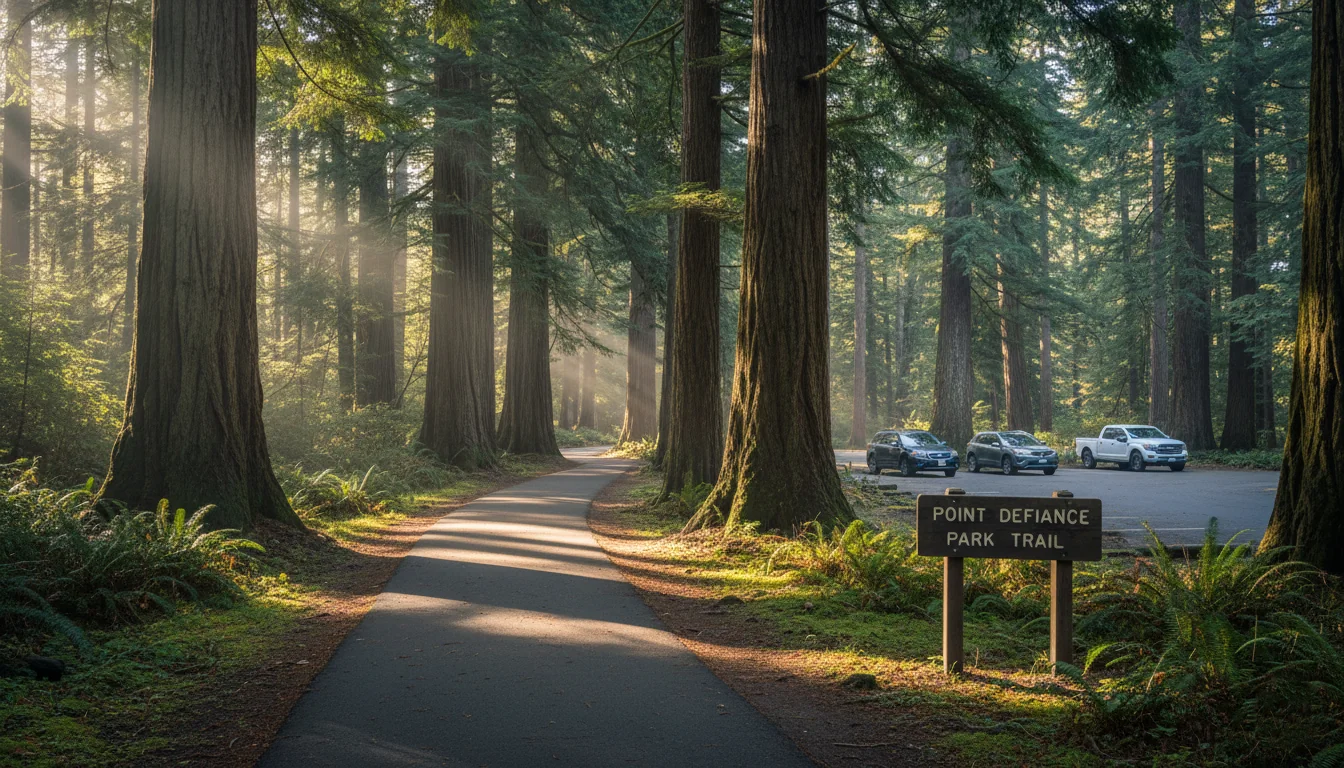
Point Defiance Park - 760 acres of trails, forest, and waterfront that saw 5 assaults and a sexual assault in 2024.
Point Defiance Park: 760 Acres, 1-2 Guards, and a Growing Problem
Point Defiance is one of the largest urban parks in the country. At 760 acres, it has trails, a zoo, an aquarium, a dog park, picnic areas, and kayak rentals. It's the crown jewel of Tacoma's park system. And in 2024, it became the setting for a series of violent attacks that forced Metro Parks to rethink everything about park security.
On February 10, 2024, a woman identified in reports as "Jane" was stabbed in the park, suffering multiple facial lacerations and a skull fracture. The suspect, Nicholas Fitzgerald Matthew, wasn't apprehended until March 29 - in San Francisco. He was charged with first-degree attempted murder.
Then on December 11, 2024, a woman was attacked and sexually assaulted near the off-leash dog park area while walking her dog as the park was closing. That suspect remains at large.
All told, Tacoma Police documented 5 assaults and 1 sexual assault in Point Defiance Park during 2024. And a child was injured in a shooting at the park in 2023.
The Camera Trailer Experiment That Failed
After the February 2024 stabbing, Metro Parks installed temporary mobile camera trailers at Point Defiance. They were removed after just 3-4 months because police said the cameras "weren't useful enough." The concept was sound, but the execution fell short. The trailers had no real placement strategy and no remote monitoring, and they weren't tied into any law enforcement response. In practice, they were recording footage nobody was watching in real time.
Joe Brady, Deputy Director of Metro Parks Tacoma, put it plainly: "We simply can't have our crown jewel park fall victim to this type of activity. It's unacceptable." He added: "We need to have a digital footprint of folks that enter the park."
Metro Parks is now planning to install 12-15 permanent camera locations throughout Point Defiance, based on police recommendations. But permanent cameras need infrastructure and take time to install, and once they're up, their sight lines are fixed. The park currently operates with just 1-2 security guards during daytime hours - and nobody at night.
Peter Sluka, who founded the Point Defiance Park Watch volunteer group in 1997, has been vocal about the need for better surveillance coverage. He's right, and almost nobody disputes that cameras belong in the park. The harder question is whether fixed cameras alone can cover 760 acres of trails, parking lots, and wooded areas, or whether mobile, rapidly repositionable surveillance needs to be part of the mix.
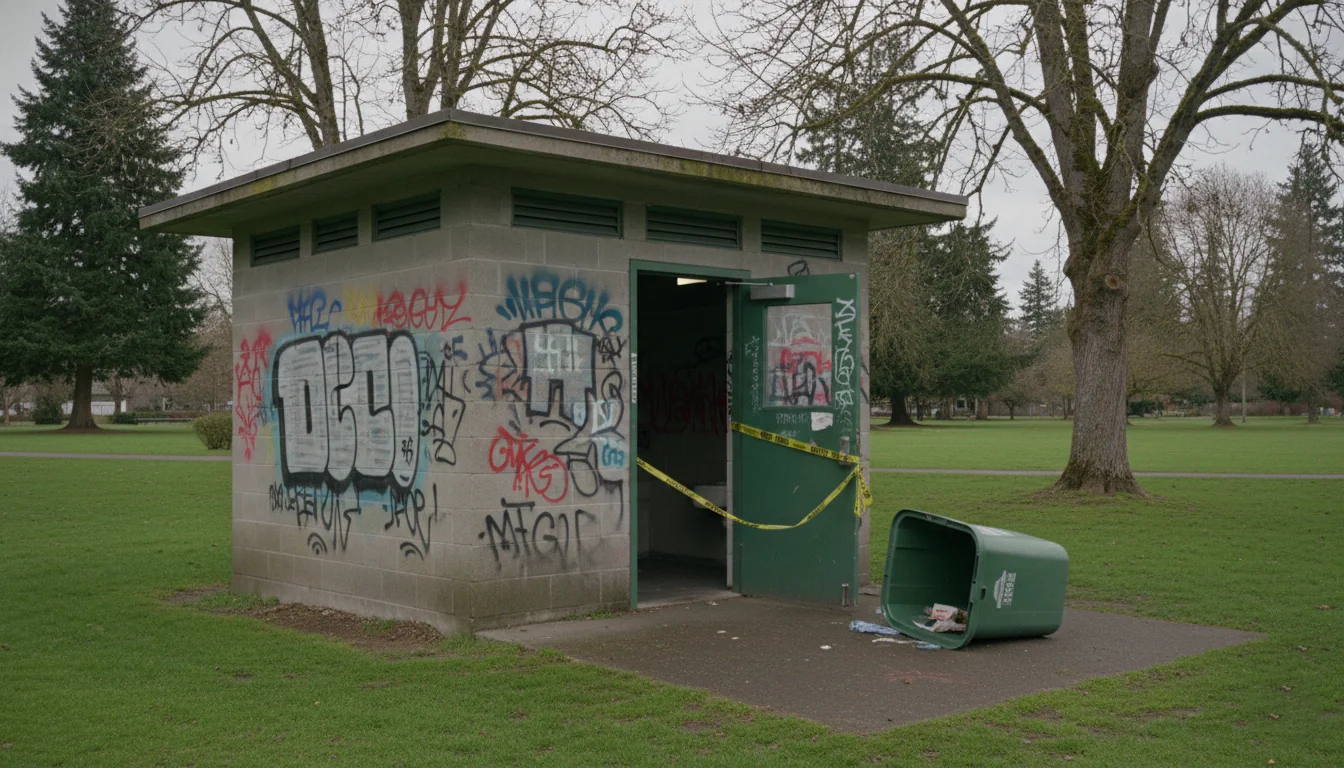
Tacoma park facilities have been hit by repeated vandalism, arson, and copper theft - costing taxpayers hundreds of thousands in repairs.
Parks Under Siege: Vandalism, Arson, and $400,000 in Damage
Point Defiance gets the headlines, but it's not the only Tacoma park with problems. The pattern of vandalism and destruction affecting Metro Parks facilities reads like a war of attrition.
South Park was hit by vandalism in December 2024 and again in March 2025. Total damage: approximately $400,000. Thieves stole copper wire - the same material driving theft at construction sites across the region - which knocked out the park's bathrooms and sprayground. Metro Parks staff told the board they hoped to have working bathrooms by May 2025, but the sprayground was unlikely to operate that entire season.
Charlotte's Blueberry Park on East D Street had 13 fruit trees stolen in March 2025 - trees that had been planted just weeks earlier. That was just the latest hit. In 2021, the same park was targeted by multiple arsons that destroyed portable toilets and park structures.
Jefferson Park on North Mason Avenue lost a WPA-era restroom building to arson - a structure described as "the only indoor fitness facility in North End parks." Portland Avenue Community Center had its building damaged by arsonists and its restroom/storage building vandalized repeatedly, forcing restroom closures pending repairs.
None of these parks had adequate surveillance at the time of the incidents. Every one of them represents a facility that went offline for weeks or months, affecting the neighborhoods that depend on them most.
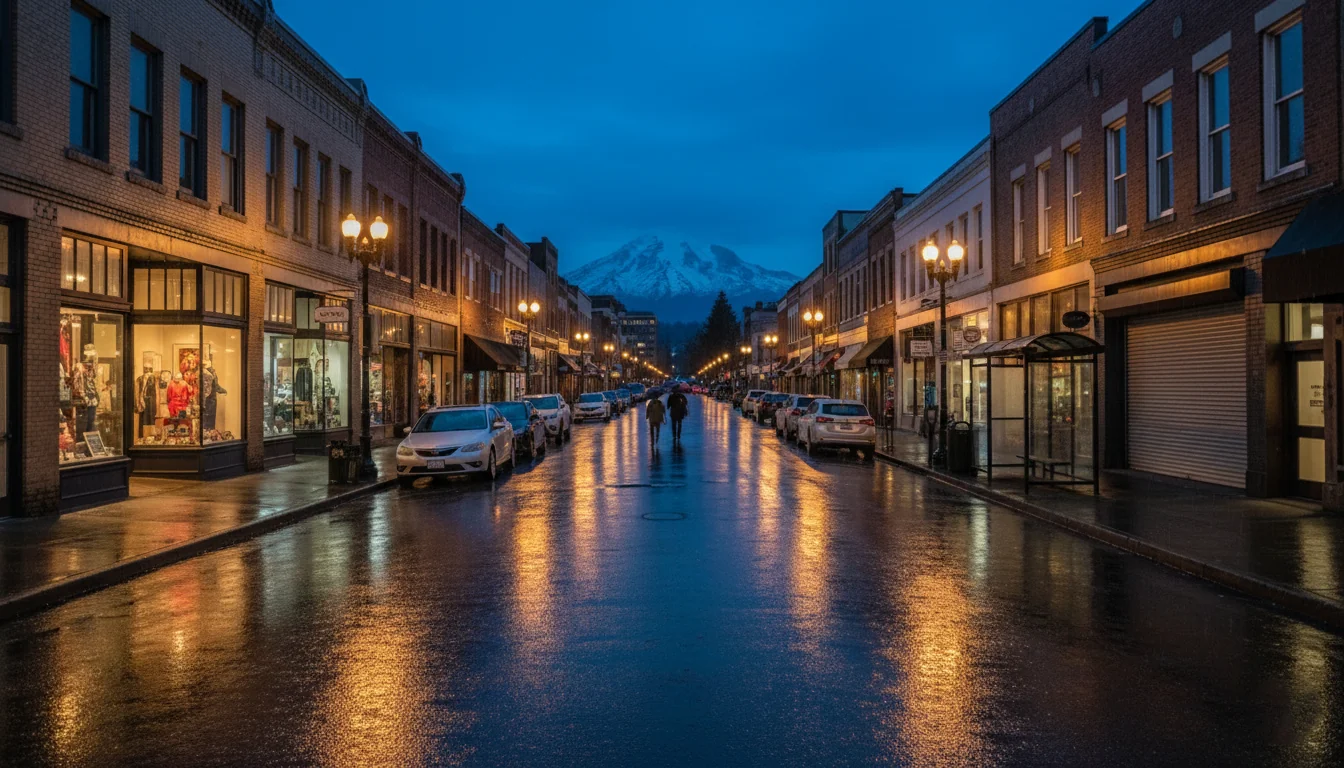
Downtown Tacoma at night - only 24% of residents say they feel safe here, despite ongoing revitalization efforts.
The Neighborhoods: Hilltop, East 25th, and Downtown
Public space safety in Tacoma isn't limited to parks. Three areas keep coming up in police reports and community surveys.
Hilltop
On February 22, 2025, 18-year-old Messiah Washington was shot and killed inside an elevator at the Housing Hilltop South apartment complex. He was surrounded by a group; at least two were captured on video holding firearms. A 15-year-old was arrested in March and charged with second-degree murder. Two 16-year-old suspects were arrested in April.
Less than a year earlier, 17-year-old De'Layah Sims was shot on the 1800 block of South 15th Street on March 23, 2024. In both cases, a teenager was shot in a public or semi-public space that had little surveillance coverage at the time.
East 25th Street Corridor
While violent crime fell across most of Tacoma in late 2024, the East 25th Street corridor - stretching from East 25th to Puyallup Avenue and from East Portland Avenue to East K Street - was the notable exception. Violent crimes in this area stayed flat while they dropped everywhere else.
Business owners along the corridor have been dealing with break-ins, drug dealing, prostitution, vandalism, and aggressive behavior. Alexx Bacon, owner of Aaberg's Rentals, described the situation to KOMO News: "Just a lot of narcotics crime, some prostitution still that we've always seen, a lot of illegal camping on the streets." His business eventually installed an electric fence to keep out intruders. Jamie Rasmussen from Aqua Rec's Fireside Hearth and Home added: "They're climbing over the back buildings to break into the warehouse. They're breaking windows. They're being aggressive."
Tacoma Police responded with increased patrols, better street lighting, and graffiti removal, but business owners said it wasn't enough. The corridor became Phase 3 of the city's Violent Crime Reduction Plan in April 2025.
Downtown
The 24% safety perception stat tells the downtown story better than any crime number could. The Downtown Tacoma Partnership operates both a Safety Team (providing security escorts and addressing nuisance behaviors) and a Clean Team (removing graffiti and maintaining streets). In September 2024, the BLOXHUB organization published a Downtown Revitalization Playbook recommending arts-led programs and converting underused buildings into multi-use hubs. But revitalization requires safety first - people won't patronize restaurants, shops, or cultural venues if they don't feel secure walking there.
What Tacoma Is Already Doing (And Where the Gaps Are)
It would be unfair to say the city isn't trying. Tacoma has invested in several initiatives that are producing measurable results.
The Violent Crime Reduction Plan
Launched in July 2022 in partnership with researchers from the University of Texas at San Antonio, this three-phase strategy targets the highest-crime neighborhoods with data-driven patrol patterns. The results have been significant: hot-spot patrol areas saw a 13% reduction in violent crime, while surrounding catchment zones saw a 19% reduction. The most effective approach - police patrols with direct community engagement - produced a 41% reduction in violent crimes. Emergency light deployments alone produced a 26% reduction.
That last comparison matters. Lights alone cut crime by 26%, while active patrols with engagement cut it by 41%. Visible deterrence works, and it works substantially better when someone is actually watching and responding.
Encampment Management
In October 2025, City Council expanded the camping prohibition to include two-block buffer zones around public schools, parks, libraries, and shelters. The city's HEAL team has referred more than 3,300 people to supportive services with a 64% acceptance rate. But Pierce County's 2025 Point-in-Time count showed 2,955 people experiencing homelessness - an 11% increase from 2024. Council Member John Hines was clear that enforcement alone isn't the answer: "This policy is not our sole response to homelessness."
Expanded Camera Authority
In 2024, Washington state passed House Bill 2384, broadening local authority for automated enforcement cameras beyond school zones and red-light intersections to include high-crash locations, park zones, and hospital zones. In December 2024, Tacoma's City Council voted to expand camera use to new high-risk areas. The city's existing red light and school zone speed cameras are traffic enforcement tools, though, and aren't used for security surveillance.
What Didn't Work: ShotSpotter
Tacoma received an $800,000 federal grant from the Bureau of Justice Assistance for ShotSpotter gunshot detection technology. Sensors were installed in a two-square-mile area around Hosmer Street. They were never activated. The program was cancelled in summer 2025, with the department stating it was "not the right time or tool for Tacoma." Roughly $300,000 in grant funds went unspent.
The Surveillance Gap Nobody Talks About
Tacoma is installing permanent cameras at Point Defiance. It has traffic enforcement cameras at red lights and in school zones. But the vast majority of Tacoma's public spaces - neighborhood parks, trailheads, community centers, downtown corridors, transit stops - have zero surveillance coverage. Fixed cameras require infrastructure buildout (power, networking, mounting) that takes months to plan and install. Meanwhile, the problems aren't waiting.
That's the gap mobile surveillance fills. A CCTV trailer can be deployed to a problem park in hours and repositioned as crime patterns shift. It provides live viewing with real-time alerts on your team's phones or computers, plus recorded evidence, without any permanent infrastructure. When the city's own Violent Crime Reduction Plan showed that visible, monitored deterrence produces a 41% crime reduction - compared to 26% from passive measures - the case for actively monitored mobile surveillance becomes hard to ignore.
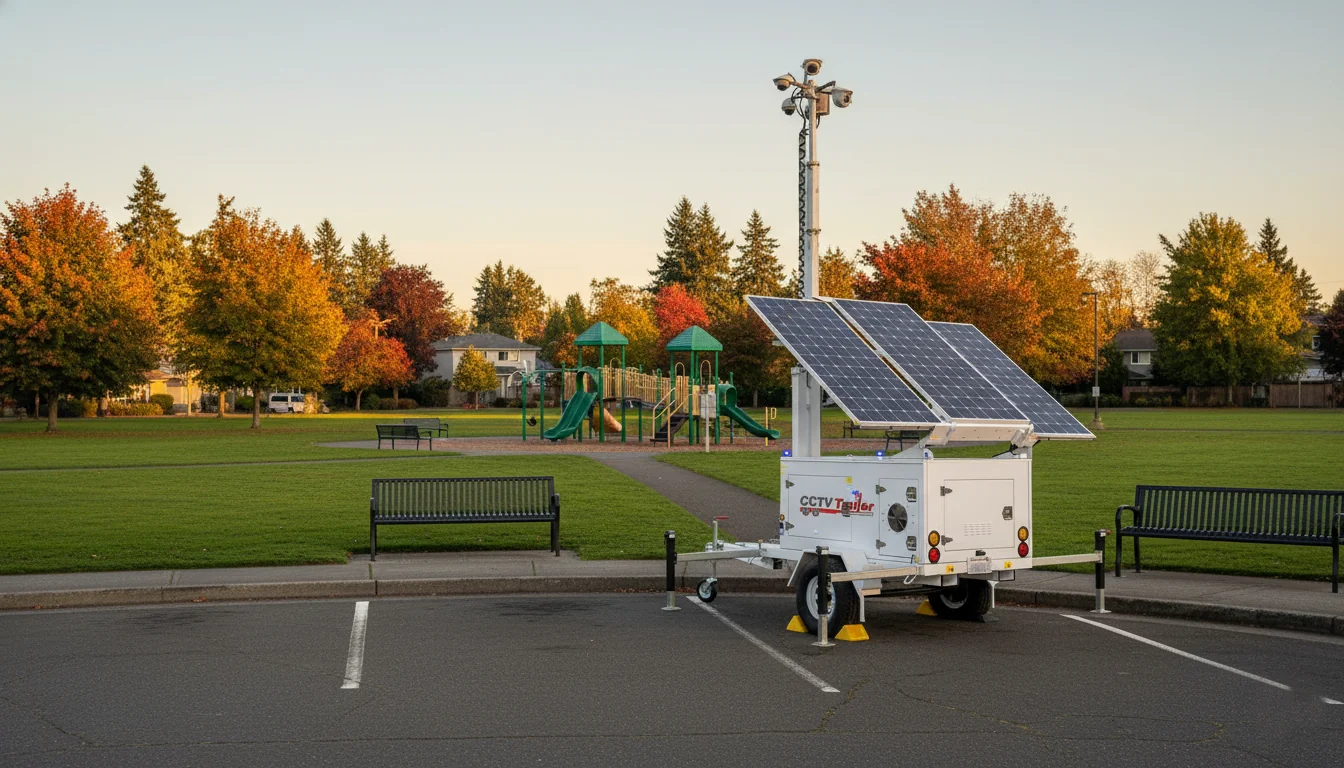
A mobile surveillance trailer deployed at a park entrance. It runs on solar power and is visible enough to deter people before anything happens.
Where Mobile Surveillance Makes the Biggest Difference
Not every public safety problem has a surveillance solution. But based on the specific patterns playing out across Tacoma, several scenarios stand out where mobile CCTV trailers deliver measurable impact.
Parks and Trailheads
Point Defiance is 760 acres. Even with 12-15 permanent cameras, that's roughly one camera per 50 acres - barely covering parking lot entrances and high-traffic areas. The off-leash dog park where the December 2024 assault occurred, the wooded trail sections, and seasonal-use areas like the kayak launch all need flexible coverage that can be adjusted as usage patterns change with the seasons.
Mobile trailers with PTZ (pan-tilt-zoom) cameras mounted at 20+ feet provide wide-angle coverage of parking lots and trailheads. They run on solar power with battery backup, so they don't need grid connections. And because they're visible - tall, clearly marked, with active deterrent lighting - they send a "someone is watching" signal that Point Defiance's brief camera experiment failed to deliver because the equipment wasn't positioned for maximum visibility.
Vandalism-Prone Facilities
South Park's $400,000 in copper theft and vandalism damage happened at a known target. Charlotte's Blueberry Park was hit by arson before the trees were stolen. Jefferson Park's WPA-era building had been a community asset for decades before it was torched. In each case, the facility was unmonitored and the damage happened at night, leaving no video evidence to aid prosecution.
A surveillance trailer positioned at a facility that's been targeted even once creates a documented deterrent zone. Our systems include AI-powered motion detection that distinguishes between animals, weather, and human activity - triggering alerts to your phone or computer only when someone approaches outside of normal hours. That's very different from a passive camera recording to a hard drive that someone checks after the damage is already done.
Business Corridors and Downtown
The East 25th Street businesses installing electric fences and the Downtown Tacoma Partnership providing security escorts both point to the same problem: there's no persistent visual deterrent in public commercial areas. Mobile CCTV trailers stationed at corridor entry points and parking areas provide 360-degree coverage and visible deterrence that both discourages criminal activity and makes residents and customers feel safer. When the city's own survey shows that safety perception is the number one barrier to downtown revitalization, that visual signal matters as much as the footage itself.
Event Security and Seasonal Needs
Tacoma hosts outdoor events, farmers markets, holiday celebrations, and community gatherings throughout the year. Each one creates a temporary public space that needs temporary security coverage. Mobile trailers can be deployed before an event, give organizers a real-time live view and alerts during it, and be relocated afterward - all without the cost of hiring security personnel for a one-time occasion.
What Other Cities Have Figured Out
Tacoma's experience mirrors challenges that cities across the country are dealing with. The ones that have seen the best results layer mobile surveillance on top of both permanent cameras and patrols. The key lessons from other jurisdictions:
- Visibility matters more than you think. Tacoma's own data showed that emergency lighting reduced violent crime by 26%. A well-positioned, clearly marked surveillance trailer creates an even stronger visual deterrent because it signals that someone is actively monitoring the area.
- Fixed cameras have fixed blind spots. Point Defiance is planning 12-15 permanent cameras. That's a start. But criminals learn camera positions. Mobile units that can be repositioned weekly or daily close the adaptation gap.
- Speed of deployment is critical. When a park has an incident, the window for a visible response is short. If security measures don't show up quickly, residents lose confidence and stop using the space - which makes it less safe.
- Evidence quality determines prosecution outcomes. Of the violent incidents documented at Point Defiance in 2024, multiple suspects remain unidentified. High-definition, continuously recorded surveillance footage - particularly from elevated camera positions - provides the kind of evidence that leads to identification and conviction.
Where Tacoma Goes From Here
Tacoma is making real progress on public safety. The Violent Crime Reduction Plan works, and the city is enforcing the expanded camping buffer zones while it adds cameras to Point Defiance. But the gap between what's being done and what's needed remains substantial - particularly for the dozens of neighborhood parks, community centers, business districts, and public gathering spaces that don't have any surveillance coverage at all.
Policing, community engagement, and social services still do the heavy lifting. Mobile surveillance covers the stretch between a community reporting a problem and the city putting a permanent solution in place. When South Park gets vandalized for $400,000 worth of damage, a surveillance trailer deployed the next day says "we're watching now." When Point Defiance has a violent assault, a mobile camera unit at the trailhead helps deter the next incident, and if one happens anyway, the footage gives investigators something to work with.
We deploy mobile surveillance trailers for city departments, park districts, business improvement districts, and community organizations across Tacoma and Pierce County, with same-day delivery available (call to check availability). If you're dealing with vandalism or safety concerns, or need temporary coverage for events or construction in public areas, get in touch or call us directly at (253) 683-2288.
About CCTV Trailer
CCTV Trailer provides mobile surveillance solutions across the Puget Sound region, headquartered in Tacoma with same-day delivery throughout Pierce County and King County (call (253) 683-2288 to check availability). Our solar-powered trailers carry 4 cameras (1 fixed fisheye + 3 PTZ with 25x optical zoom and IR) with AI-powered analytics, 4G/5G connectivity for 24/7 self-monitoring and remote viewing on your mobile devices or computer, and elevated camera positions for maximum coverage area.
We work with construction companies, municipalities, park districts, event organizers, and businesses to provide flexible, effective surveillance coverage without the cost and timeline of permanent camera installations. Learn more about our team and technology.
Need Surveillance for a Public Space or Park?
Deploy mobile CCTV coverage at parks, trailheads, community centers, and business corridors - same-day delivery available throughout Tacoma and Pierce County (call to check availability).
✓ Same-Day Delivery Available ✓ Solar Powered - No Grid Needed ✓ 24/7 Self-Monitoring & Remote Viewing
Related Resources
Vandalism Prevention Solutions
Mobile surveillance solutions designed to prevent vandalism and property damage at parks, public facilities, and infrastructure.
Learn more >Event Security
Mobile surveillance for public events, festivals, and outdoor gatherings throughout the Puget Sound region.
Learn more >Copper Wire Theft Prevention
Protect park infrastructure and public facilities from copper theft that costs Tacoma parks hundreds of thousands in damages.
Learn more >Tacoma Security Trailer Rental
Local mobile surveillance deployment throughout Tacoma and Pierce County with same-day delivery available.
Learn more >Security Trailer vs Guards
Cost comparison between mobile surveillance trailers and traditional security guard patrols for public spaces.
Learn more >Same-Day Security Rental
Emergency surveillance deployment for parks and public areas experiencing sudden safety concerns.
Learn more >Event Security - Seattle & Tacoma Summer 2026
How the same public-space crime patterns shape event planning for Tacoma's summer 2026 festival calendar.
Learn more >Washington Retail Theft Crisis
Where public space safety and retail theft overlap - and what visible surveillance changes for both.
Learn more >