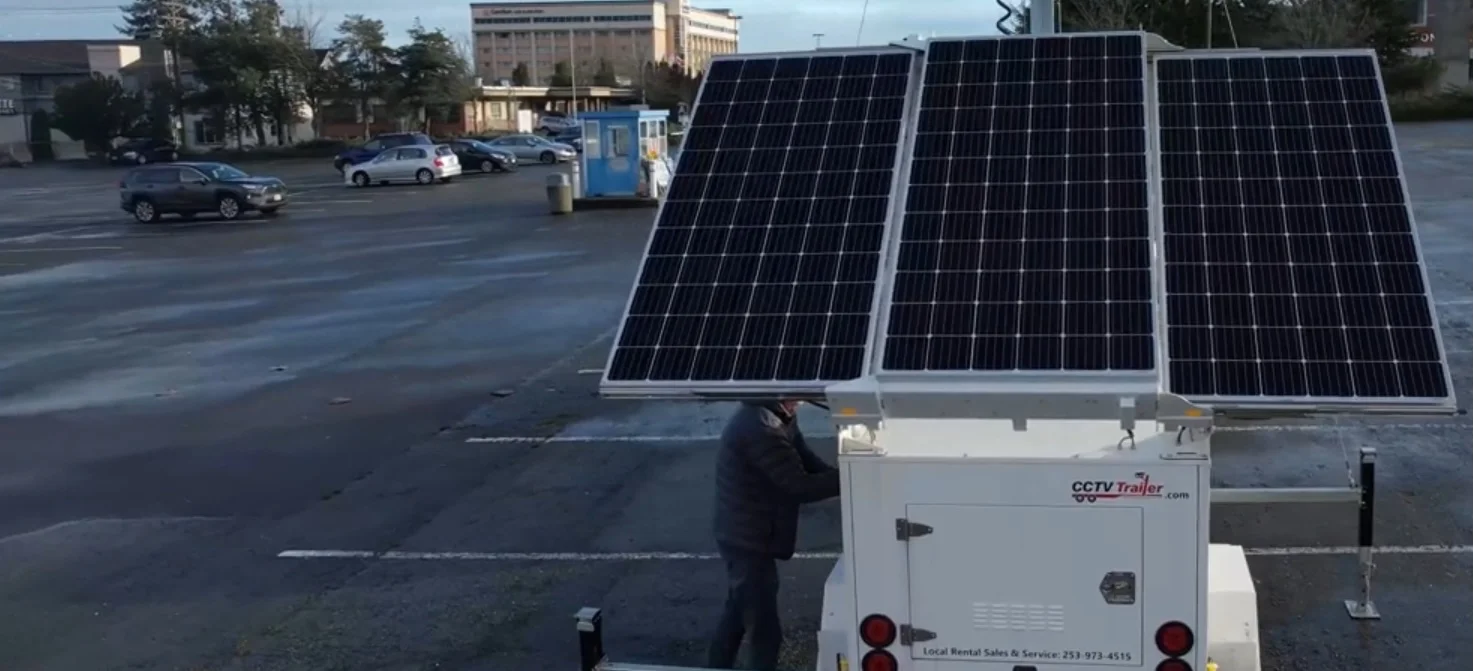
Wireless Security Systems
Deploy professional security anywhere in minutes. Our wireless systems run on cellular networks and solar power, so they don't need local power lines or internet.
Get Wireless QuoteWireless System at a Glance
Enterprise-grade security without infrastructure dependencies
4G/5G Cellular Connectivity
- Multi-Carrier Support
Automatic failover between Verizon, AT&T, T-Mobile
- Unlimited Data Plans
No bandwidth caps or throttling
- Edge Computing
Local processing means less video has to cross the cellular link
- Encrypted Transmission
Military-grade end-to-end encryption
Power Independence
- Solar + Battery Hybrid
Continuous operation without grid power
- 72-Hour Backup
Extended operation during outages
- Intelligent Power Management
Adaptive consumption based on conditions
- Hot-Swappable Batteries
Zero downtime maintenance
Wireless vs Wired System Comparison
| Feature | Wireless 4G/5G | Wired Internet | Traditional CCTV |
|---|---|---|---|
| Deployment Time | ✓ 30 minutes | 2-4 weeks | 3-6 weeks |
| Infrastructure Required | ✓ None | Internet + Power | Full cabling |
| Location Flexibility | ✓ Anywhere with cell signal | Near existing services | Limited to buildings |
| Initial Cost | ✓ No installation cost - call for a quote | $10,000-25,000 | $15,000-40,000 |
| Scalability | ✓ Instant | Requires planning | Major construction |
| Relocation Capability | ✓ Same day | New installation | Not practical |
| Weather Resilience | ✓ Excellent | Cable dependent | Cable vulnerable |
| Maintenance | ✓ Remote updates | On-site required | Regular on-site |
Wireless 4G/5G
Wired Internet
Traditional CCTV
Coverage Area Calculator
Recommended Wireless Configuration
Units Required
2
Coverage Area
100%
Monthly Data Usage
480 GB
Advanced Wireless Technology Features
AI Edge Processing
On-device AI analyzes video locally and sends only relevant alerts, which keeps bandwidth use down. May 2026 measurement: FDC live remote view used ~46% less LTE/5G uplink than direct RTSP for the same camera - see the live-stream uplink methodology.
Mesh Network Capability
Multiple units form a self-healing mesh network, so coverage holds even if one unit loses connectivity.
5G Ready
Future-proof hardware supports 5G networks for lower latency and faster data speeds.
Thermal Imaging
Optional thermal cameras detect heat signatures in complete darkness, fog, or smoke conditions.
Instant Alerts
Real-time push notifications to mobile devices with live video streaming of detected events.
Analytics Dashboard
Reports with heat maps, traffic patterns and security incident analysis.
Ideal Applications for Wireless Security
Rapid Deployment Scenarios
- Emergency Response
Deploy security after incidents - about 30 minutes to set up once on site
- Pop-up Events
Temporary security for festivals and gatherings
- Disaster Areas
Monitor damaged infrastructure post-disaster
- Mobile Operations
Follow equipment as it moves between sites
Remote & Challenging Locations
- Rural Construction
Sites miles from nearest infrastructure
- Utility Infrastructure
Power lines, substations, water treatment
- Transportation Hubs
Rail yards, ports, logistics centers
- Historic Buildings
Protect without invasive installation
Technical Specifications
Camera Specifications
- Cameras 1 fixed fisheye + 3 PTZ
- Resolution 4K (8MP)
- Frame Rate 30 fps
- Night Vision 300ft IR
- PTZ Range 360° pan, 90° tilt
- Optical Zoom 25x (PTZ)
- Weather Rating IP67
Connectivity Specs
- Primary Network 5G/4G LTE
- Backup Network 3G/Satellite
- Bandwidth 150 Mbps down
- Encryption Military-grade
- VPN Support Yes
System Features
- Storage 2 weeks onboard (extendable)
- Cloud Backup Unlimited
- AI Analytics Edge processing
- Integration REST API
- Mobile App iOS/Android
- Users Unlimited
Frequently Asked Wireless Questions
How reliable is 4G/5G for security surveillance?
Modern 4G/5G networks are dependable, and our systems add automatic failover between multiple carriers. Multi-carrier SIMs switch automatically between Verizon, AT&T, and T-Mobile.
What happens if cellular service is temporarily unavailable?
The system continues recording locally, with two weeks of motion-only onboard storage by default (extendable in special cases). Once connectivity returns, footage automatically syncs to the cloud. Critical alerts can be sent via satellite backup if configured.
How much data does wireless surveillance use?
Usage depends on how much activity the cameras see and how often you watch live. With AI edge processing, the system transmits mainly when motion is detected, and compression cuts the bandwidth further. All plans include unlimited data.
Can wireless systems integrate with existing security?
Yes, our wireless systems integrate with most existing security platforms via REST API, ONVIF protocol, or RTSP streams. We can also provide hybrid solutions combining wireless and wired cameras on the same platform.
How quickly can wireless security be deployed?
Complete deployment takes 30 minutes to 2 hours depending on site size. Units arrive pre-configured and connect automatically. No permits, trenching, or infrastructure work required - just position and power on.
Ready to Secure Your Site?
Tell us about your site and get a quote in minutes
✓ Same Day Delivery ✓ No Long-Term Contracts Required ✓ 24/7 Support