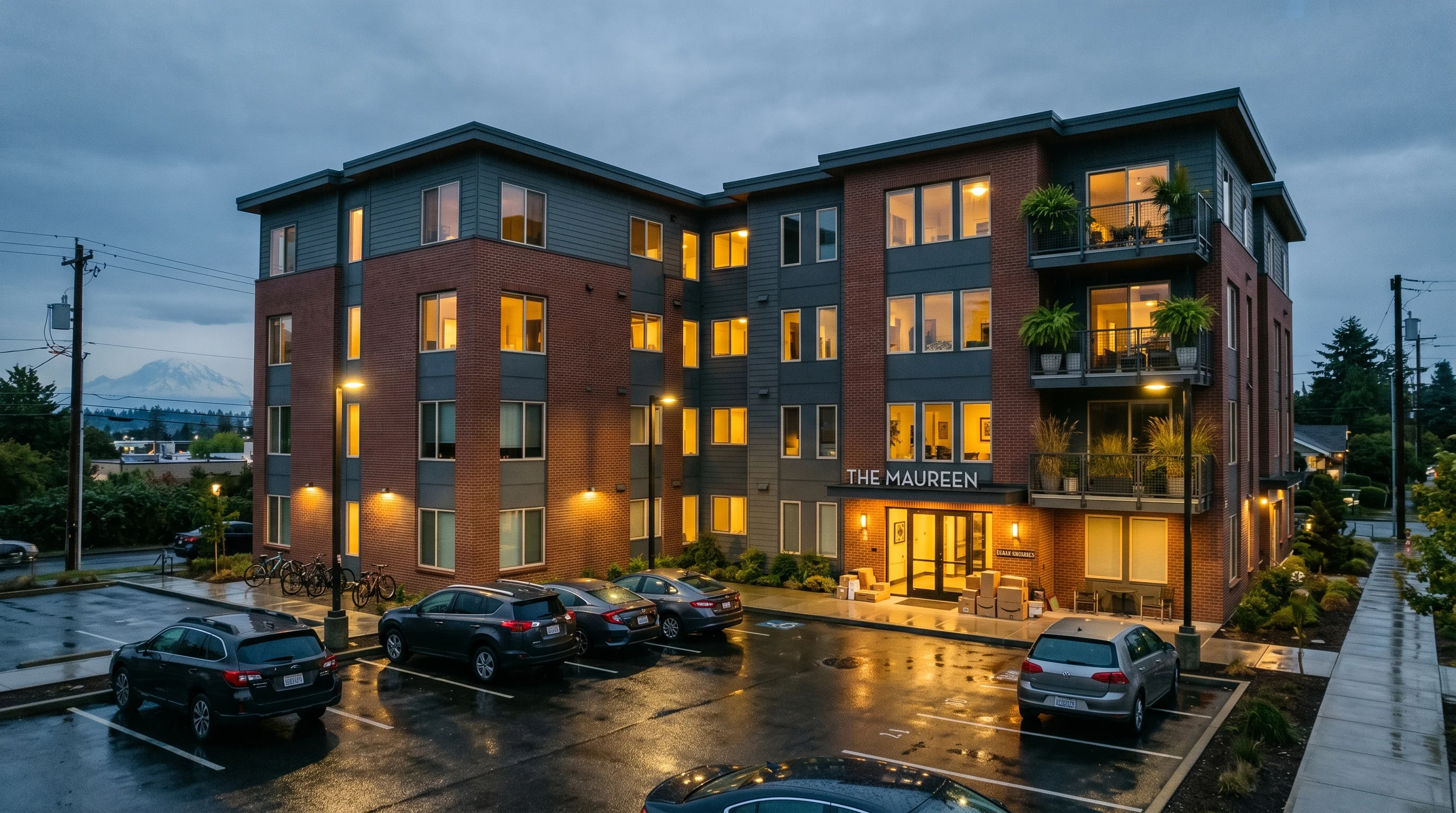
Apartment Security in the Puget Sound: Package Theft, Car Prowls, and Why "Secure" Parking Often Isn't
Seattle-Tacoma-Bellevue has ranked at the top of America's worst metros for package theft for three years running. A "secure" gated garage in Belltown had 10 cars broken into overnight last December while tenants paid $275 a month for parking. Kent's Phoenix Court Apartments has logged eight confirmed shootings. Federal Way saw three fatal apartment-complex shootings in 2025 alone. And mail thieves are still pulling up to cluster mailboxes with a single stolen USPS arrow key that opens every box in a ZIP code. If you manage a multi-family property in the Puget Sound, this is what 2026 looks like.
Quick Answer
How bad is crime at apartment complexes in the Seattle-Tacoma area and what can property managers actually do about it?
The Seattle-Tacoma-Bellevue metro has consistently ranked among the worst in the nation for package theft, with an estimated 104 million packages stolen nationally each year at a cost of roughly $16 billion. Multi-family properties report higher theft rates than single-family homes due to shared package and mail areas. Gated parking garages are routinely breached - a Belltown complex lost 10 vehicles in a single overnight in December 2025. Car prowls and stolen firearms from vehicles remain stubbornly high: 206 guns were stolen from Seattle vehicles in 2025. Mail theft using stolen USPS arrow keys - which sell for $1,000 to $7,000 on the dark web - continues to hit cluster mailboxes across the region. And several Puget Sound complexes have become repeat sites for violence: Kent's Phoenix Court has logged 8 shootings, and Federal Way saw three fatal apartment-complex shootings in 2025. A 40-year meta-analysis from the Office of Justice Programs found CCTV surveillance delivers its largest and most consistent crime-reduction effects in parking areas and residential properties, particularly when combined with lighting and active monitoring. Mobile surveillance trailers give property managers elevated 360-degree coverage with deterrent-level visibility - typically deployed within 24 hours and without infrastructure changes.
The Package Problem Isn't Getting Better
If you manage a building in Seattle, Tacoma, Bellevue, or anywhere in between, you already know this one. Packages disappear, residents complain, Amazon reships, and a week later it happens again. What the national data tells us is that the Seattle-Tacoma-Bellevue metro has been near the top of the country's worst package-theft rankings for years. A SafeWise analysis reported in the Seattle Times placed our metro as the nation's most impacted for porch piracy, and follow-up reporting through 2025 kept it firmly in the top tier.
The scale nationally is hard to picture until you see the raw number. SafeWise's 2025 analysis estimates roughly 104 million packages stolen in a single year, representing about $15-16 billion in lost merchandise. And the same report notes something property managers already suspect: apartment complexes report higher theft rates than single-family homes, because the delivery target is always in the same shared lobby, mailroom, or leasing-office doorway.
The federal response has finally shown up. On December 23, 2025, a bipartisan group introduced the Porch Pirates Act, which extends the FBI's and Department of Justice's authority over interstate delivery theft all the way to the customer's door. Before that change, federal protection essentially stopped once the package left the truck. Whether or not the bill passes, its introduction tells you the problem has grown past what local theft statutes can manage.
For a property manager, the frustrating reality is that most apartment-building package theft is routine work. People who steal packages for a living watch the delivery routes. They know which buildings have unmanned lobbies or cameras pointed the wrong way, and some know exactly when a side door gets propped open. Catching individual thieves rarely changes much. The realistic goal is to make your building a worse target than the one across the street.
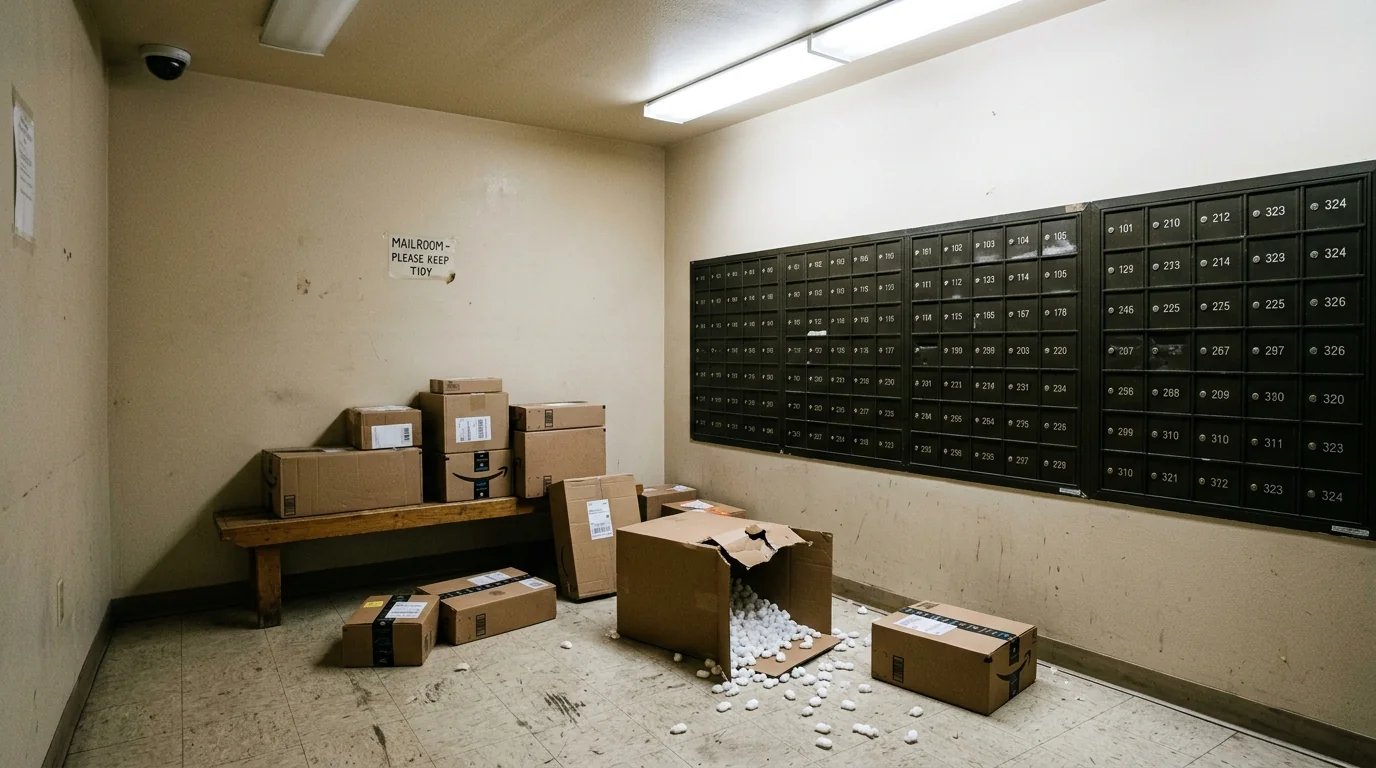
Shared mailrooms and unmanned lobbies are the single largest vulnerability for multi-family properties across the Puget Sound - delivery patterns are predictable, and thieves know it.
The Belltown Garage That Proved "Gated" Means Nothing
On December 4, 2025, tenants at Walton Lofts at 75 Vine Street in Belltown woke up to find at least ten vehicles broken into inside the building's own gated parking garage. Tenants there pay $275 a month for that space. The garage had cameras, but the ones that mattered weren't working. Residents publicly threatened to break their leases. Building management spent the following week explaining what happened.
From a pattern-recognition standpoint, the Walton Lofts incident is useful because it was so typical. A few weeks earlier, West Seattle Blog reported repeat garage break-ins tied to a suspect driving a dark-blue Prius. The same pattern - follow a resident through the roll-up gate, wait for them to disappear into the elevator, then spend thirty minutes working the row - shows up in garage after garage across the region. The gate is mostly symbolic. Once a vehicle is inside, the cameras are often missing or aimed at the wrong spaces, and even the good ones usually aren't being watched.
That last piece matters more than the hardware itself. The Office of Justice Programs' 40-year meta-analysis of CCTV found the largest, most consistent crime-reduction effects in parking areas and residential settings - but the effect size climbs significantly when surveillance is actively monitored instead of passively recording. Footage that nobody looks at until after a break-in only tells you what already happened.
The Citywide Numbers Tell a Complicated Story
The Seattle Police Department's 2025 Year in Review reports a 7% reduction in car prowls citywide and a 24% reduction in stolen vehicles - roughly 1,821 fewer victims compared to the prior year. King County overall reported a 22% drop in overall crime, with property crime including auto theft down nearly 50%. That's genuine progress.
Here's where property managers have to read the fine print. Citywide averages are not the same as the numbers at your specific building. SPD's own data still shows 206 firearms stolen out of Seattle vehicles in 2025, which means car prowlers are still working parking facilities the way they always have, and some of them walk away armed. If your complex hasn't seen a meaningful reduction in reported incidents, the citywide trend doesn't help you. It just means the criminals in your neighborhood haven't moved on yet.
Vehicle Theft: The Kia/Hyundai Wave Isn't Fully Over
The Kia and Hyundai theft wave that started in late 2022 is past its peak but still shaping risk at apartment lots. In the first two weeks of January 2023, Tacoma saw 348 vehicles stolen - 48% of them were Kias or Hyundais, compared to just 5% in the same window a year earlier. Seattle saw Kia thefts climb 363% and Hyundai 503% from 2021 to 2022. Both cities filed lawsuits against the manufacturers, and free software upgrades eventually rolled out through mobile clinics.
The improvement in 2024-2025 is real - King County's overall auto theft drop bears that out. But the vehicles that weren't patched are still parked at apartment complexes across the Puget Sound. And the TikTok-driven method the original wave made famous gave existing car thieves a new technique, one they haven't forgotten. A property manager with an open lot full of 2015-2021 model-year vehicles still has exposure, whether or not the headlines have moved on.
Catalytic Converters: Mostly Solved
Here's a bright spot. Washington's ESHB 2153 took effect April 1, 2025, requiring licensed purchasers, three-year record retention, and creating new felony penalties for trafficking. The results have been fast. State Farm reported a 74% year-over-year drop in Washington catalytic-converter theft claims in the first half of 2024, on top of a 77% decline in 2023 - the largest of any state.
If catalytic converter theft was the exposure driving security decisions at your property two years ago, that's worth revisiting. The threat profile has shifted. What remains high is vehicle break-ins, firearms stolen from parked cars, and targeted vehicle theft of a shrinking but still-present pool of older Kia and Hyundai models.
The Mail Theft Problem Most People Don't See
A USPS "arrow key" is the master key that opens every cluster mailbox in a ZIP code. It's meant to be in the possession of one letter carrier. In practice, arrow keys are stolen off carriers - sometimes at gunpoint - and then resold. KIRO 7 reported that these keys move on the dark web for anywhere from $1,000 to $7,000. Once somebody has one, every cluster box in that ZIP - including the ones at your apartment complex - is open to them until USPS rekeys the route.
Neighborhoods across the Puget Sound keep getting hit. West Seattle cluster mailboxes were compromised in both November 2024 and June 2025. Residents reported stolen checks, identity-theft follow-ups, and the slow, frustrating process of working through USPS Postal Inspection Service complaints. For apartment complexes that rely on cluster boxes as the primary mail delivery point, one stolen arrow key can mean every tenant in the building has their mail opened, sometimes for weeks before anyone notices the pattern.
The Postal Inspection Service has acknowledged the scale. Its Project Safe Delivery program, launched in 2023, is in the process of replacing 49,000 arrow locks nationwide with electronic versions that don't have a single physical master. That's the right fix. But Seattle's specific rollout timeline hasn't been announced, and until it reaches your route, every cluster box in your building sits behind the same shared lock.
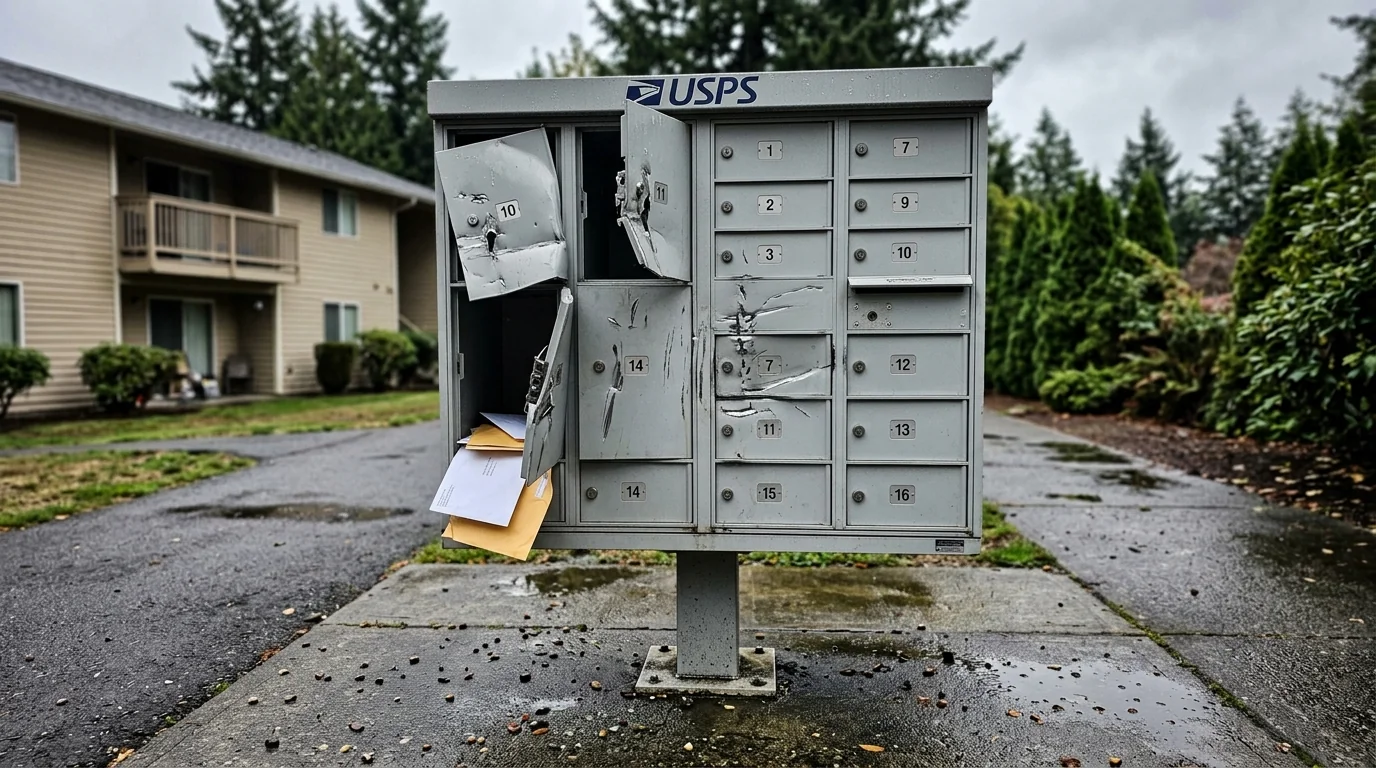
Cluster mailboxes at apartment complexes are a single point of failure - one stolen USPS arrow key opens every box in the ZIP until the route is rekeyed.
The Violence at Specific Complexes
Nobody likes this section of the piece, but it's the one property managers ask about most when we sit down with them. Some multi-family properties in the Puget Sound have become repeat sites for serious violent crime, and the incidents aren't random.
Kent: Phoenix Court Apartments
The Kent Police Department publicly characterized Phoenix Court Apartments as a "hub for extraordinary violent crime," citing eight confirmed shootings - two of them fatal. For a single property, that's a level of law-enforcement attention that almost always precedes either a management change, a lease-up collapse, or both.
Federal Way: Pavilion, Glen Park, and Beyond
Federal Way alone saw three fatal apartment-complex shootings in a four-month stretch in 2025. A young woman was killed by gunshot at Pavilion Apartment Homes on February 13. Three days later, a 24-year-old Tacoma man was shot and killed at Glen Park at West Campus. On May 3, a 20-year-old man was fatally shot at another Federal Way complex.
Everett: Gateway Apartments
On June 2, 2025, two juveniles - ages 11 and 17 - were shot at Everett's Gateway Apartments in what Everett PD described as gang-related. The 11-year-old's injuries alone are the kind of detail that changes how neighboring complexes think about their own risk, and how insurance underwriters price those policies.
None of this means every apartment complex is unsafe. Most properties across the Puget Sound have no shootings and no serious violent incidents. But for the complexes that do, the pattern is often similar: early signs of trespassing, vandalism, or loitering get managed passively, and by the time anyone acknowledges there's a pattern, the property's reputation with tenants and with law enforcement has already shifted.
The Landlord Liability Angle
Washington operates under a comparative negligence doctrine, which means a property owner can be held partially liable for tenant injuries or property losses even when a tenant also shares some fault. The practical effect, as summarized by Washington landlord insurance analyses, is that $500,000-$1,000,000 liability limits plus a $1-2 million umbrella policy (roughly $200-$400/year) have become standard guidance for multi-family operators. The average Washington landlord liability claim exceeds $22,300, with property-damage claims averaging over $9,800. Documented surveillance shifts the negotiation. When the cameras worked and the footage exists, a plaintiff's attorney has far less room to argue about what "should have been there." Missing footage or a non-functional camera on the night of an incident is often the piece that moves a routine case into a punitive one.
What Actually Works at Multi-Family Properties
The research on what reduces crime at residential and parking-lot environments is more mature than most people realize. A 2025 peer-reviewed study published in the Justice Evaluation Journal reinforced the OJP meta-analysis: CCTV is specifically effective at reducing property crime, with the strongest results in car parks and residential settings. What both bodies of research also make clear is that CCTV alone doesn't reduce violent crime - it has to be layered with lighting, access control, and, ideally, a real-time response capability.
The Layers That Matter
- Elevated surveillance over the whole parking area. Storefront-height cameras miss the back rows where most garage prowls actually happen. A 20+ foot camera position with PTZ capability covers what a row of fixed cameras under the eaves can't.
- Active monitoring. The OJP meta-analysis specifically calls out active monitoring as the driver of the largest effect sizes. That can mean 24/7 self-monitoring with real-time alerts to a manager's phone, or a third-party monitoring service. Footage that nobody sees until the morning after can't stop anything.
- Lighting across the full lot and garage. LED floodlighting is one of the cheapest and most consistent crime deterrents in the CPTED (Crime Prevention Through Environmental Design) research.
- Two-way audio or voice-down capability. Many prowls, trespassing incidents, and suspicious loitering end the moment somebody realizes they're being watched in real time. Speaker announcements or a live voice-down from whoever is watching is more effective than sirens.
- Cellular-connected, off-site storage. On-site NVRs can be disabled or stolen. Footage that has already transmitted off-site can't be destroyed by the person in frame.
- License plate recognition at entry points. Organized prowl crews and known-offender vehicles reuse plates. A pattern only becomes visible if somebody is actually reading the plates.
- Package lockers or a staffed receiving point. Architectural solutions to package theft outperform camera-only approaches. If a package never sits unattended in a shared space, the theft vector closes.
- Clear trespass notices and documented enforcement. In Tacoma, property owners can file a No Trespass Authorization with TPD, which lets officers remove unauthorized individuals without a property-manager having to call about every incident. Pierce County maintains a dedicated Unauthorized Encampments portal as well.
Why Fixed Cameras Aren't Enough for Most Apartment Lots
Most apartment complexes already have cameras - usually mounted under eaves at 10 to 12 feet, covering the front entrance and maybe the leasing office. A portion of the parking rows sits in frame. The footage records to an NVR in a back office that nobody watches in real time. After a break-in, somebody pulls the tape, discovers the license plate isn't quite readable, and files it with a police report that goes into the backlog. You've probably lived this exact cycle.
Fixed cameras do a fine job at entrances, mailrooms, and amenity areas. But for the parking garage - especially the back rows, where organized prowl crews actually work - a camera at storefront height watching a fixed angle is simply seeing the wrong spaces. The problem happens in the gaps between the cameras, and it always has.
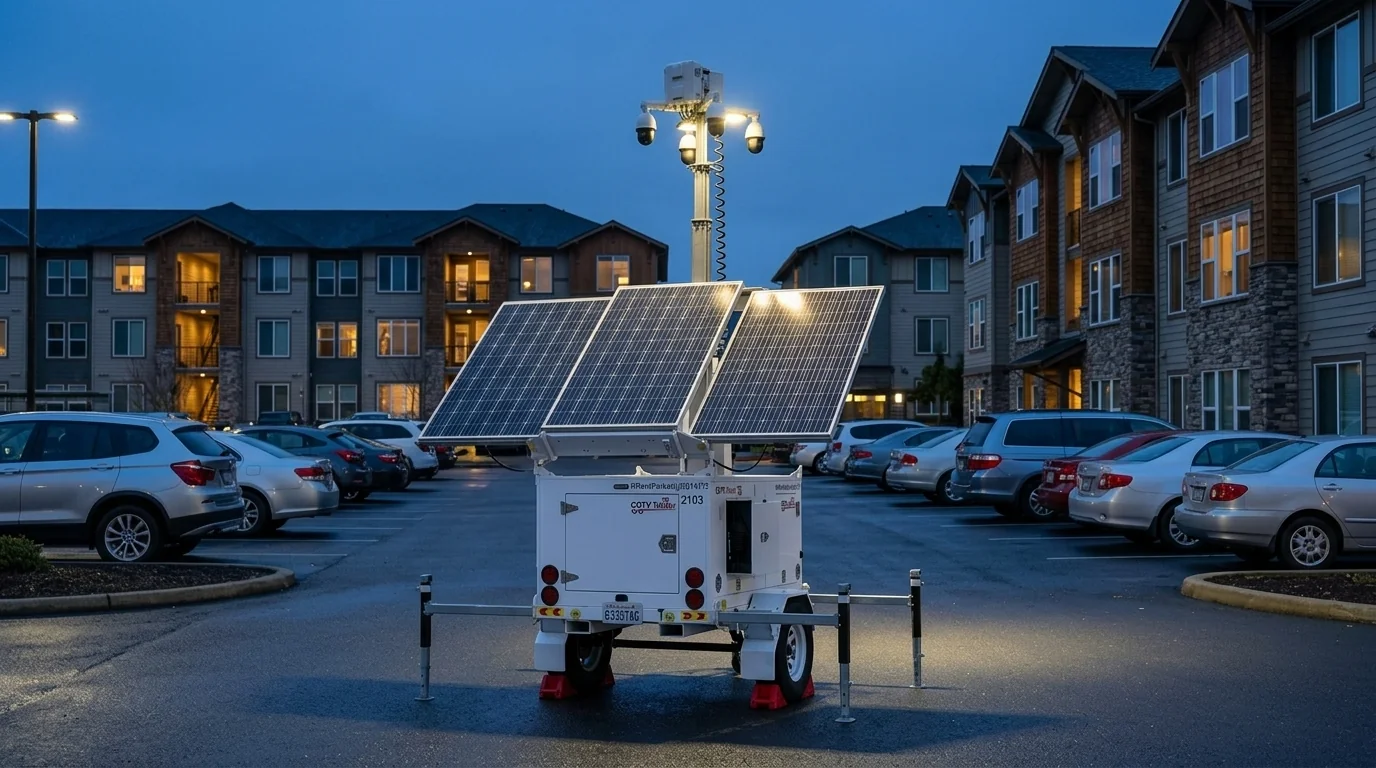
A mobile surveillance trailer at the entrance of an apartment lot - the elevated PTZ position covers the entire parking area and creates the visible deterrent that fixed cameras under the eaves can't.
Where Mobile Surveillance Fits
Keep the fixed cameras at the front door. A mobile surveillance trailer is what you deploy when you have an active problem - a run of prowls, a recent shooting nearby, a period of construction where contractors are pulling permits and trades are coming and going - and you need a visible, operational presence on the property within 24 hours.
A single trailer parked at the lot entrance sits at 20+ feet of elevation, carries 4 cameras - 1 fixed fisheye for a 360° overview plus 3 PTZ cameras with 25x optical zoom and IR night vision - and runs on solar power so it doesn't depend on tapping into building electrical. It connects over 4G/5G cellular for remote viewing on your mobile devices or computer, pushes AI-tagged alerts to your phone when unusual activity is detected, and offers two-way audio so you or your staff can speak to someone on site in real time. One unit covers a parking area that would take many fixed cameras to cover properly.
More importantly, it's visible. Prowl crews driving through apartment complexes at 3 a.m. are sizing up which property looks watched, and they tend to pick the one without the tower.
For a property manager, the math is usually simpler than it looks. A single serious incident at a complex, like a shooting or a mail-theft event that spirals into identity theft for ten residents, can cost more in tenant turnover and insurance premium hikes than a year of surveillance coverage. Deployed as a temporary response to an active problem, or seasonally during higher-risk months, mobile surveillance is one of the most direct tools property managers have to break a pattern before it becomes the building's reputation.
The Insurance and Lease Angle
Documented surveillance coverage, especially with timestamped, AI-tagged footage, is increasingly a factor in how commercial property insurance premiums are set on multi-family properties, and an active system in place can help at renewal. It also changes claims dynamics. A break-in or assault claim with clear footage resolves faster and with fewer disputes than one where the camera "was supposed to be working." And on the leasing side, prospective tenants in 2026 are asking security questions during property tours that they weren't asking five years ago. A visible, working surveillance setup helps with lease-up and retention, too.
What This Means for Puget Sound Property Managers
Crime statistics across Seattle and King County are improving, and that's real. But citywide averages don't decide what happens at your property. What happens at your own gate and in your own garage does, and those patterns are still very much alive across the Puget Sound in 2026. Package theft in this metro has been near the top of the national rankings for three years. Gated garages are getting breached in Belltown, West Seattle, and everywhere in between. Cluster mailboxes share a single key that moves for four figures on the dark web. And a small number of complexes across Kent, Federal Way, and Everett have become repeat sites for serious violence that almost always started smaller.
What property managers can control is the security posture. Forty years of research shows that visible surveillance, especially when it's actively monitored and paired with good lighting and access control, delivers its largest crime-reduction effects in parking areas and residential settings. That describes most of an apartment complex. What's left to decide is whether your property is the one the prowl crew drives past or the one they stop at.
We've been deploying mobile surveillance across apartment complexes, condo associations, HOA properties, and mixed-use buildings in the Puget Sound since 2009. Our solar-powered, cellular-connected trailers are built for PNW weather. If you're a property manager or owner dealing with a rise in incidents - or trying to get ahead of a pattern before it becomes one - we'll do a free site assessment. Get in touch or call us at (253) 683-2288.
About CCTV Trailer
CCTV Trailer is a locally owned mobile surveillance company headquartered in Tacoma, serving the Pacific Northwest since 2009. Our solar-powered trailers carry 4 cameras (1 fixed fisheye + 3 PTZ with 25x optical zoom and IR) with AI-powered analytics, 4G/5G connectivity for 24/7 self-monitoring and remote viewing on your mobile devices or computer, two-way audio, and elevated positions for maximum parking-area coverage. Same-day delivery is available throughout Pierce and King counties - call (253) 683-2288 to check availability.
We work with apartment owners, condo associations, property management companies, shopping centers, construction sites, and event organizers to provide flexible, effective surveillance coverage without the cost and timeline of permanent installations. Learn more about our team and technology.
Dealing With a Rise in Incidents at Your Property?
Get mobile surveillance deployed at your apartment complex, condo, or multi-family property - same-day delivery available (call to check availability), solar powered, no infrastructure required.
✓ Same-Day Delivery Available ✓ Solar Powered - No Grid Needed ✓ 24/7 Self-Monitoring + Two-Way Audio
Related Resources
Same-Day Security Rental
Emergency mobile surveillance for apartment complexes, condo associations, and property managers dealing with active crime problems.
Learn more >Vandalism Prevention Solutions
24/7 surveillance to deter vandalism, graffiti, and property damage across multi-family and commercial properties.
Learn more >Retail Parking Lot Security
Mobile surveillance for commercial parking lots and mixed-use properties where apartments sit above or next to retail.
Learn more >Auto Dealer Lot Security
How visible surveillance stops the same organized vehicle-theft crews that target apartment garages across Pierce and King counties.
Learn more >Tacoma Public Space Safety
What the crime data actually shows for public and common-area spaces across Tacoma - the same patterns hit apartment grounds.
Learn more >Security Trailer vs Guards
Cost comparison between mobile surveillance trailers and traditional security guard patrols for multi-family properties.
Learn more >