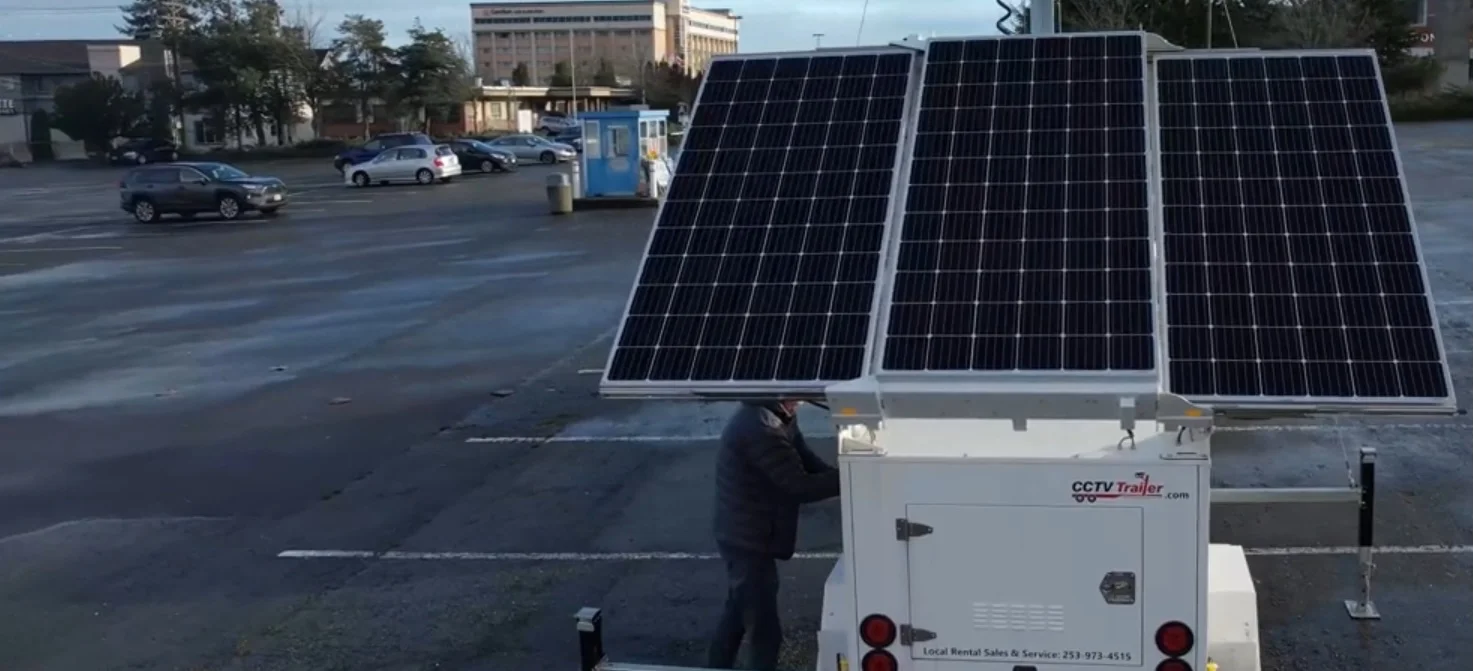
Solar Powered Security Trailers
Deploy eco-friendly security anywhere in the Pacific Northwest with our solar powered surveillance trailers. No power connection is needed, and the trailers run 24/7 with zero emissions, even through Seattle and Tacoma's cloudy winters.
Get Solar QuoteSolar Surveillance System Performance
Reliable security powered entirely by renewable energy
Solar Power Calculator
Solar Capacity Required
2.4 kW
Panel array size
Battery Storage
14.4 kWh
72-hour backup
Power Savings
$1,800/mo
vs. generator power
Solar vs Traditional Power Comparison
| Feature | Solar Powered | Grid Connected | Generator Powered |
|---|---|---|---|
| Initial Setup Cost | ✓ Solar power included with rental | $5,000-15,000 | $3,000-5,000 |
| Monthly Operating Cost | ✓ $0 | $300-500 | $1,500-2,500 |
| Deployment Time | ✓ 20-30 min setup | 2-4 weeks | 4-6 hours |
| Location Flexibility | ✓ Anywhere | Near power lines | Anywhere (with fuel) |
| Reliability | ✓ Battery-buffered | Subject to grid outages | Subject to fuel supply |
| Maintenance | ✓ Annual cleaning | Minimal | Weekly refueling |
| Environmental Impact | ✓ Zero emissions | Grid dependent | High emissions |
| Noise Level | ✓ Silent | Silent | 65-75 dB |
| Weather Resilience | ✓ 72hr battery backup | Grid dependent | Fuel dependent |
| Long-term ROI | ✓ Highest | Medium | Lowest |
Solar Powered
Grid Connected
Generator Powered
Advanced Solar Technology Features
High-Efficiency Panels
Monocrystalline silicon panels with a 22% efficiency rating get the most out of low-light Pacific Northwest days. View full technical specifications.
Smart Battery Management
LiFePO4 batteries paired with intelligent charge controllers are rated for a 10+ year lifespan and perform well in all weather.
Power Optimization
MPPT tracking adjusts power draw to the available sunlight, so the system keeps running through extended cloudy periods.
Auto-Tracking System
Optional solar panel tracking follows the sun's path throughout the day to increase energy harvest.
Remote Power Monitoring
Real-time power generation and consumption monitoring via web dashboard, with alerts for any system issues.
Weather Resistant
IP67 rated components withstand extreme weather, from -40 degrees F to 140 degrees F, with hail and wind resistance.
Perfect Applications for Solar Surveillance
Pacific Northwest Applications
- Construction Sites (Tacoma-Seattle Corridor)
No power hookup needed at new development sites along I-5 and surrounding areas. Learn about construction security.
- Timber & Logging Operations
Protect equipment and monitor access roads at remote forestry sites in Washington and Oregon with no infrastructure
- Agricultural Monitoring
Protect crops and equipment across large acreage at Yakima Valley farms, Skagit Valley tulip fields, and Pacific Northwest cannabis grows
- Port & Maritime
Solar-powered perimeter surveillance for Port of Tacoma and Port of Seattle container yards, with no power lines to run across sprawling terminals
PNW Environmental & Public
- Olympic National Park & Forest
Zero-emission security for protected federal lands. Silent, clean solar power helps meet strict environmental requirements
- Puget Sound Shoreline
Monitor sensitive marine ecosystems with no fuel spill risk or exhaust near critical salmon habitat and shellfish beds
- Washington State Parks
Silent monitoring for camping areas, trailheads, and day-use facilities that won't disturb visitors or wildlife
- Tribal Lands
Security for sovereign nations without permanent infrastructure. Trailers deploy and leave without a footprint on culturally significant sites
Environmental Impact Benefits
No power hookup or trenching
Fuel consumption
Zero noise pollution
Certification points
Pacific Northwest Solar Performance
Does solar work in rainy Seattle and Tacoma? Yes, and here are the numbers.
The PNW Solar Reality
A lot of people assume our cloudy skies make solar impractical in the Pacific Northwest. The sun-hour figures say otherwise:
- - Seattle averages ~4.0 peak sun hours daily (annual average)
- - Tacoma averages ~4.1 peak sun hours daily (annual average)
- - Summer months (May-September) deliver 6-8 peak sun hours, more than many southern cities
- - Winter months (November-January) drop to 1.5-2.5 hours. That's when our 72-96 hour battery backup matters most
Configured for PNW Conditions
Our trailers are specifically configured for Pacific Northwest conditions with oversized battery banks and panel arrays. Unlike off-the-shelf solar systems, we design for worst-case PNW winter performance:
- Oversized solar arrays (up to 4.8 kW) to capture maximum energy on short winter days
- Extended battery banks (up to 28.8 kWh) for multi-day cloudy stretches
- Panels optimized for diffuse light under cloudy skies as well as direct sun
- Included hybrid backup generator that starts on its own when battery voltage drops
Month-by-Month Solar Performance: Tacoma / Seattle
| Month | Peak Sun Hours | System Capacity | Battery Reliance | Performance Notes |
|---|---|---|---|---|
| January | 1.5 hrs | 35-40% | High | Battery backup critical; included generator covers the gaps |
| February | 2.5 hrs | 50-55% | Moderate | Improving daylight; oversized panels compensate |
| March | 3.5 hrs | 70-75% | Low | Spring ramp-up; most days fully self-sufficient |
| April | 4.5 hrs | 85-90% | Minimal | Strong output; batteries fully charged daily |
| May | 6.0 hrs | 100% | None | Excellent output; surplus energy stored |
| June | 7.0 hrs | 100%+ | None | Peak performance; longest days of the year |
| July | 8.0 hrs | 100%+ | None | Best month, with clear skies and long days |
| August | 7.0 hrs | 100%+ | None | Excellent; typically driest month in PNW |
| September | 5.5 hrs | 100% | None | Strong performance; Indian summer common |
| October | 3.5 hrs | 70-75% | Low | Fall transition; rain returns but still adequate |
| November | 2.0 hrs | 40-50% | Moderate | Shorter days; battery backup engaged regularly |
| December | 1.5 hrs | 35-40% | High | Lowest output; battery plus the included generator |
Peak sun hours represent equivalent hours of full sunlight intensity (1,000 W/m2). System capacity percentage indicates solar generation relative to system demand. All figures based on historical NREL data for the Tacoma-Seattle area.
What this means on a real jobsite, including tree shade, cold-morning charging and storm outages, is in our winter guide for Tacoma, Seattle and Olympia jobsites.
Solar System Specifications
Solar Panel Specifications
| Panel Type | Monocrystalline Silicon |
| Power Output | 400W per panel |
| Efficiency | 22.5% |
| Array Size | 6-12 panels (2.4-4.8kW) |
| Operating Temp | -40 degrees F to 185 degrees F |
| Warranty | 25 years |
Battery System Specifications
| Battery Type | LiFePO4 (Lithium Iron) |
| Capacity | 14.4 - 28.8 kWh |
| Backup Duration | 72-96 hours |
| Charge Cycles | 6,000+ cycles |
| Depth of Discharge | 95% |
| Lifespan | 10-15 years |
Power Management System
MPPT Controller
- - 98% conversion efficiency
- - Multi-stage charging
- - Temperature compensation
- - Remote monitoring
Inverter System
- - Pure sine wave output
- - 3000W continuous
- - 6000W surge capacity
- - Auto-transfer switch
Monitoring Features
- - Real-time power tracking
- - Battery health monitoring
- - Weather integration
- - Predictive analytics
Frequently Asked Solar Questions
How do solar security trailers work in cloudy weather?
Solar panels still generate power on cloudy days, at reduced output, and the 72-96 hour battery backup keeps the system running through extended cloudy periods. The system automatically manages power consumption to prioritize essential functions. For the most demanding PNW winter deployments, our hybrid backup power system provides an additional safety net with automatic generator failover.
How does solar compare to generator power on operating cost?
Solar has no fuel cost and needs little maintenance. Running a site on a generator can cost roughly $1,500-2,500 a month in fuel and upkeep, and it adds refueling logistics that solar avoids.
Can solar trailers operate year-round in northern climates?
Yes, modern solar security trailers operate reliably year-round even in Seattle and Portland. Winter performance is enhanced with panel angle adjustment, snow-shedding coating, and larger battery banks to compensate for shorter days.
How much maintenance do solar panels require?
Solar panels require minimal maintenance - typically just annual cleaning and inspection. The panels have no moving parts and come with 25-year warranties. Battery systems require checking every 6 months, with replacement after 10-15 years.
What happens if the batteries run out during an extended storm?
Every rental includes a backup generator that starts automatically when battery voltage drops and recharges the batteries. Grid power can also be connected where a site has it. Our support team is notified when the generator needs fuel.
Ready to Secure Your Site?
Tell us about your site and get a quote in minutes
✓ Same Day Delivery ✓ No Long-Term Contracts Required ✓ 24/7 Support
Looking to buy a security trailer? Here's why most Puget Sound contractors rent instead.
CCTV Trailer is a rental-only service - we don't sell equipment. But most of our customers were originally shopping to buy, and chose rental after seeing the math:
- Purchase: $20,000-$65,000 upfront + ongoing cell data, maintenance, PTZ calibration, NVR firmware, physical security, and the staff time to watch it all.
- Rental: trailer with 4 cameras (1 fixed fisheye + 3 PTZ with 25x optical zoom and IR), solar power/generator, equipment training, 24/7 technical support, and remote viewing on your mobile devices or computer. Professional delivery and setup available.
- No capital outlay: for jobsites, events, and seasonal deployments, rental almost always wins on total cost. Call for a quote on your project.
If you still want to purchase, industry vendors like WCCTV and Edge CCTV sell comparable units. For Puget Sound projects, we'd rather get a trailer deployed at your site today than have you wait 4-8 weeks for a purchase to ship.
Related Solar & Surveillance Resources
Construction Security
Protect active construction sites across the Tacoma-Seattle corridor with rapid-deploy mobile surveillance trailers.
Learn more >Trailer Technology
Explore the advanced technology behind our mobile surveillance trailers including cameras, AI analytics, and connectivity.
Learn more >Standalone Hybrid Power
Learn about our hybrid solar-battery-generator power architecture designed for Pacific Northwest conditions.
Learn more >Technical Specifications
Detailed specs on cameras, solar panels, battery systems, and connectivity for our surveillance trailers.
Learn more >How to Setup Security Trailer
Step-by-step guide to deploying and configuring your mobile security trailer on-site in under 30 minutes.
Learn more >Rental Options & Quotes
Short-term and long-term rental options for mobile surveillance trailers. Call or request a quote.
Learn more >